Photos of People Coming Back Home Again From War
Historical // Getty Images
50 historic photos from American military history
On the globe phase, every bit a leading military superpower, Americans have been involved in wars and conflicts to protect nations, to fight for American values and republic, and to support allied nations whose conflicts accept results on a global calibration. Beyond our reasons for engagement, 1 aspect of living in a free, democratic country is existence aware of the sacrifices of those who give all to defend the rights of the people. Keeping alive the actions and history of a nation allows u.s. to be enlightened of how to move forward into the time to come as individuals, and as a nation.
Each military branch, from the Ground forces and Marines, to the Air Force, Navy, and Declension Guard, take gone through dramatic strategic and technological advances throughout their history. Sailing vessels became steel-powered diesel fuel ships capable of protecting the entirety of the planet's oceans. Aircraft grew from biplanes to the modern jet-powered fighters we run across today. Warfare went from lines of troops and trenches to highly strategic, multifaceted combat leaning more on applied science than on private soldiers, though a armed services is simply as strong as the people who serve within.
America'due south military machine history includes countless moments of triumph and loss during conflicts in locations both at habitation and abroad. From the American Revolution to the end of the Gulf War, over 42 1000000 people have served in the United states Military during wartime. The losses suffered are countless and only a fraction of the stories of their piece of work, heroism, and sacrifice are told. Often a single moving-picture show says more than words ever could. The following are images ranging from rescues to moments when our troops finally render home.
Stacker compiled both well-known and lesser-known photographs from Getty Images—each has its identify in American military history. Shown here are mothers, sons, fathers, and daughters who were drafted or enlisted, and who served their country throughout the generations. These snapshots offer a window into the lives of veterans and civilians during moments in military history.
You may also like: U.S. cities with the cleanest air
1 / 50
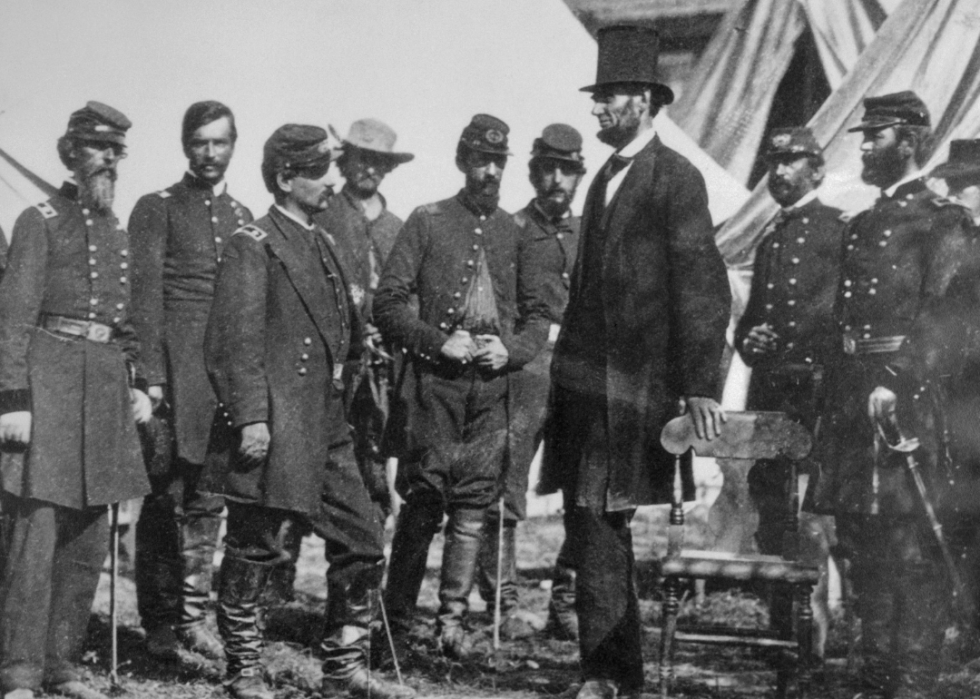
1862: Abraham Lincoln at Antietam during Civil War
The boxing of Antietam was known equally one of the most important wins for the Union troops, though information technology was also known as the bloodiest boxing in United states history. Shown here is President Abraham Lincoln with General George B. McClellan at his headquarters at Antietam on October. iii. From left are: General George W. Morell, Col. Alexander S. Webb, Full general McClellan, scout Adams, Dr. Jonathan Letterman, unidentified officeholder, President Lincoln, Col. Henry Hunt, Full general Fitz, John Porter, and an unidentified officer.
2 / l
Hulton Archive // Getty Images
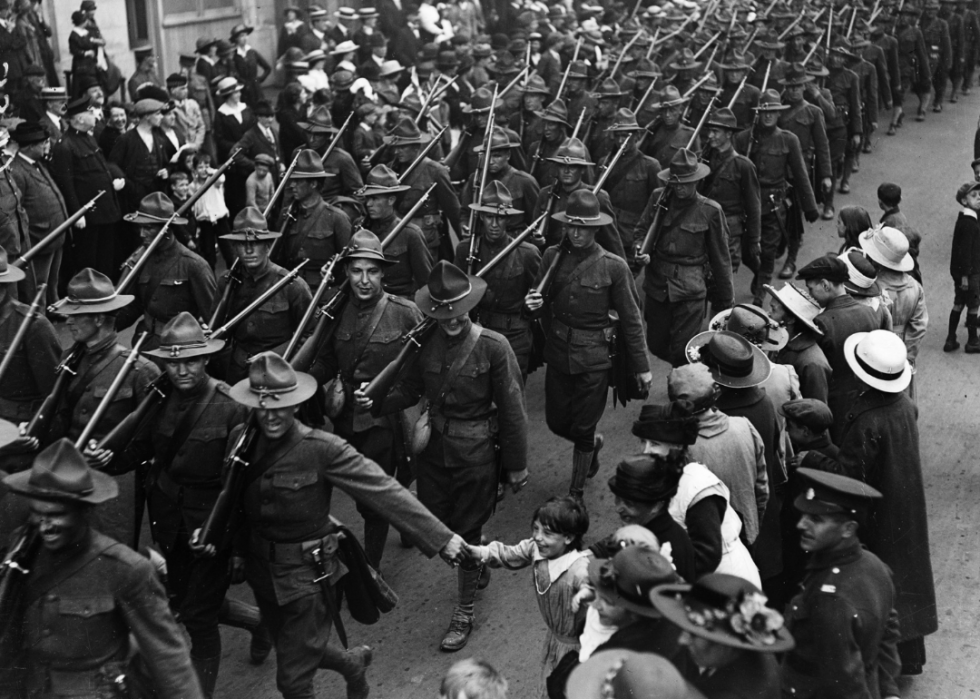
1917: Welcoming
An American soldier in August of 1917 shakes hands with a young member of the watching public as his troop parades through the streets of London. The offset earth state of war, besides known as The Great War, began in Europe in 1914. Later on the The states declared war on Deutschland in 1917, they remained involved until the war's end in 1918.
3 / 50
Annal Photos // Getty Images
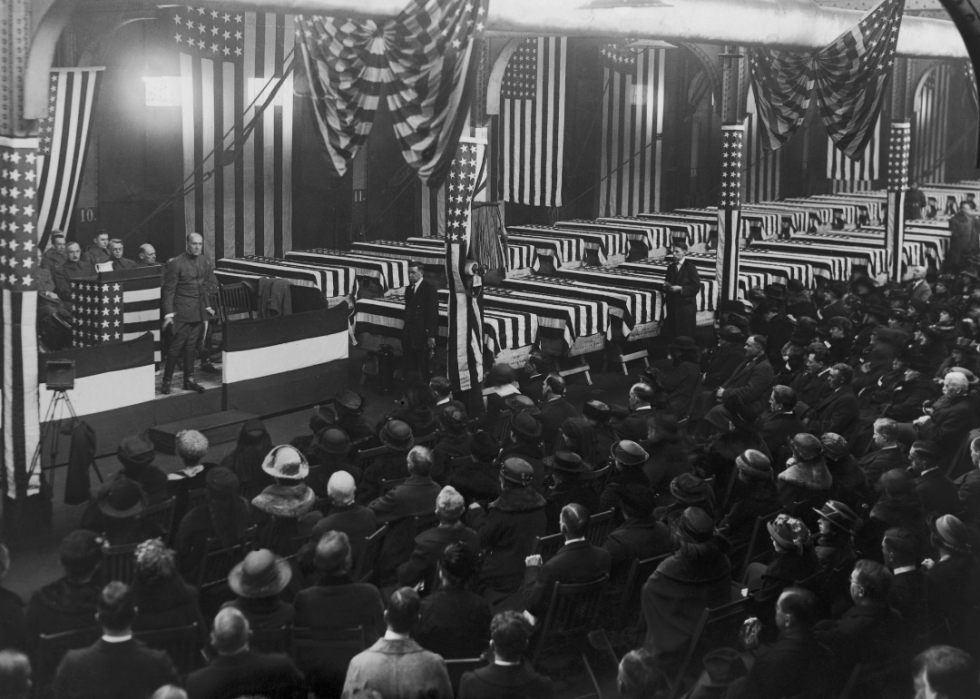
1918: Service for war expressionless
A service is held in Hoboken, New Jersey, for American soldiers, who died on the battlefields of France during Globe State of war I. The war claimed the lives of over 100,000 American service members, and injured more than than twice that amount.
four / 50
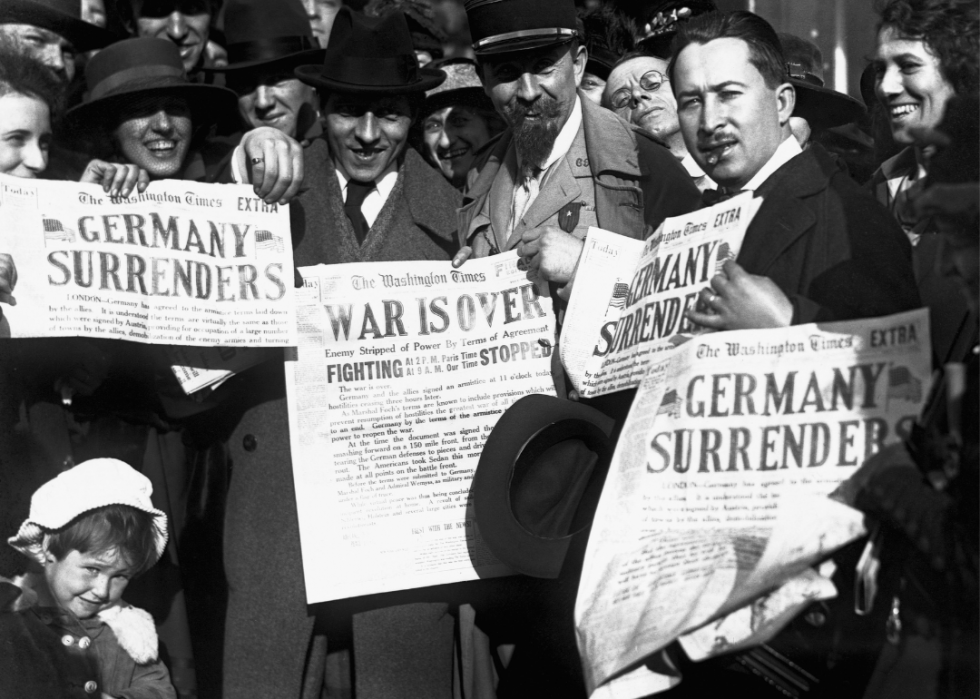
1918: Paper headlines on Armistice Day
Celebrating Americans in Washington D.C., show newspaper headlines which announce the surrender of Federal republic of germany, catastrophe World War I, Nov. 8, 1918. The Usa sent over a 1000000 troops into Europe alone throughout the duration of the war.
v / fifty
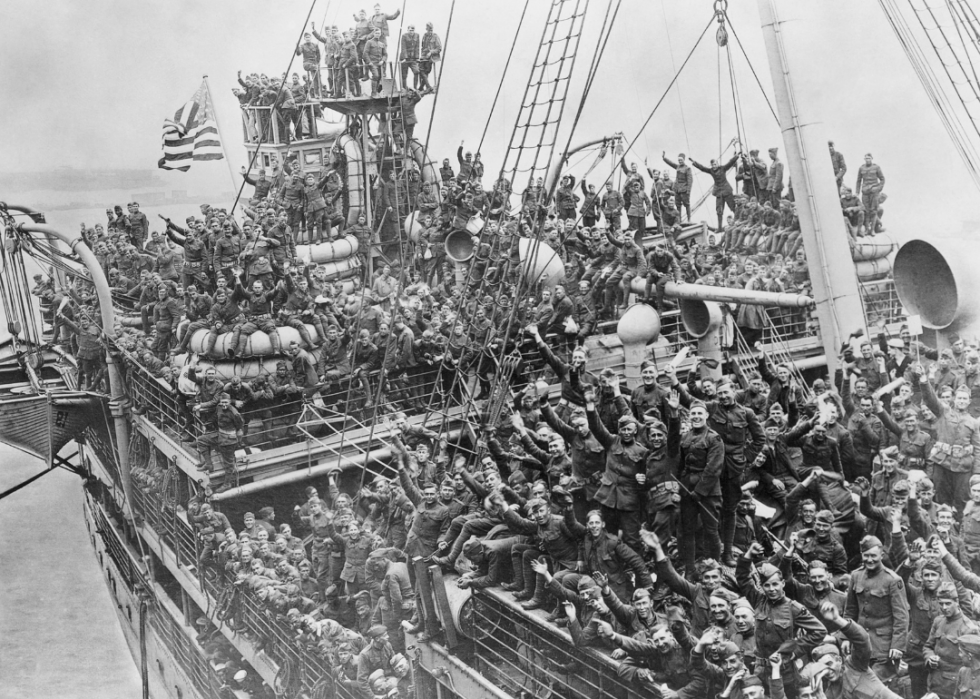
1919: Ship of soldiers returning habitation
Soldiers on the USS Agamemnon cheer as they return home to Hoboken, New Jersey, from battles in French republic. The deck of the transport is crowded with cheering soldiers. Over iv.v million Americans served the Us War machine war efforts.
You may also like: How America has inverse since the first Demography in 1790
6 / 50
Hulton Archive // Getty Images
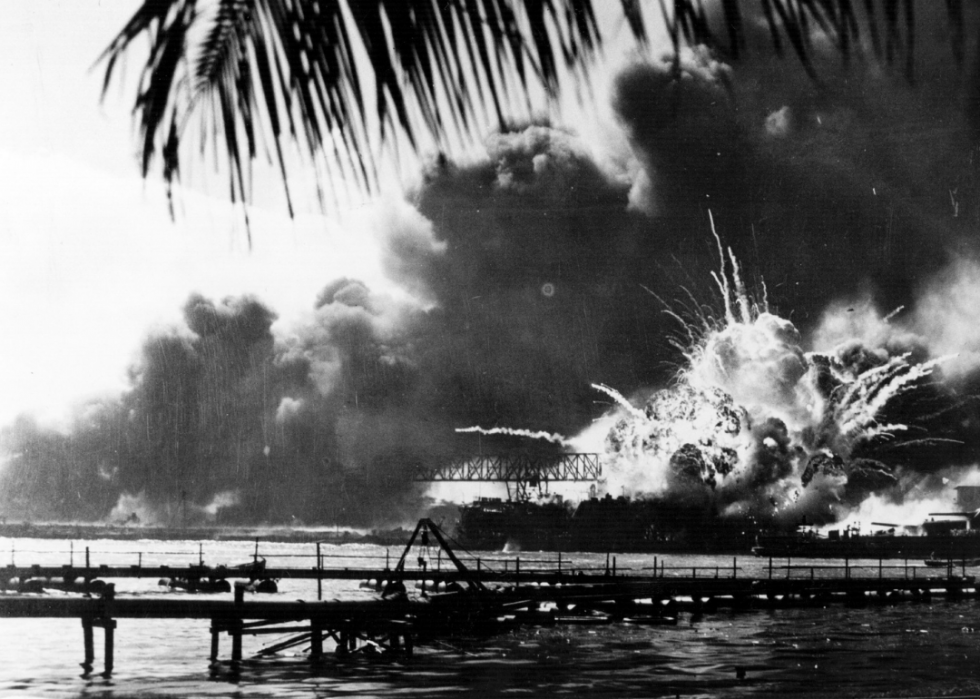
1941: Assault on Pearl Harbor
The American destroyer USS Shaw explodes during the Japanese set on on Pearl Harbor, abode of the American Pacific Fleet during World State of war II. The set on from Japan came equally a complete surprise and was followed before long later past Italy and Deutschland declaring war on the United States.
seven / 50
Archive Photos // Getty Images
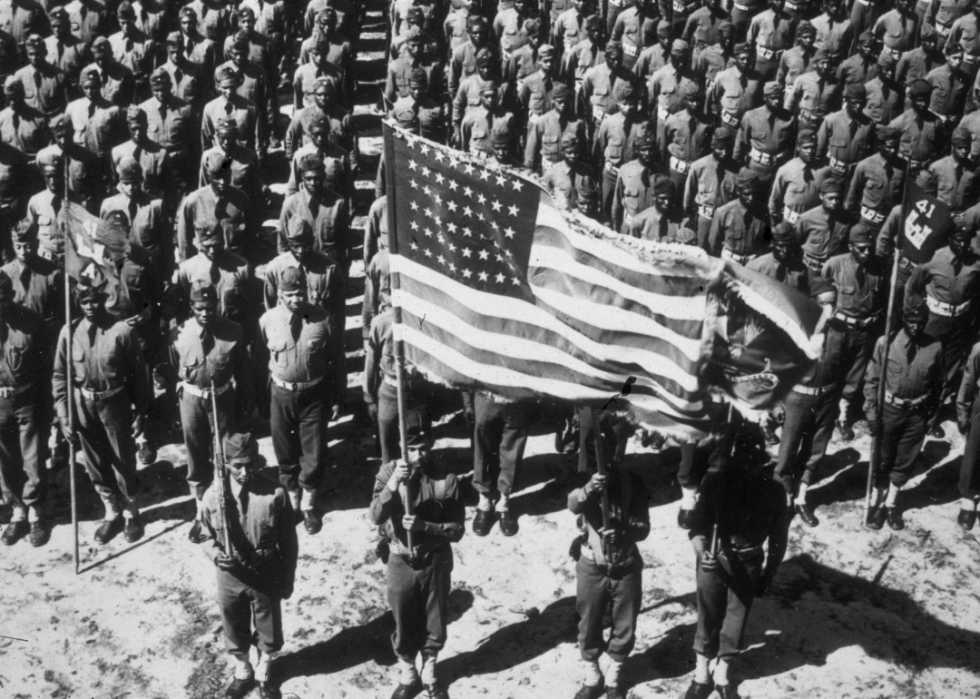
1942: Battalion of ground forces engineers
Grouping view of the soldiers of the 41st Corps of Engineers, an African American army battalion, standing in formation and holding the American flag in Fort Bragg, North Carolina. African American soldiers notwithstanding fought in segregated units during Globe War Ii. The Usa Military did not desegregate units until 1948.
8 / fifty
Corbis Historical // Getty Images
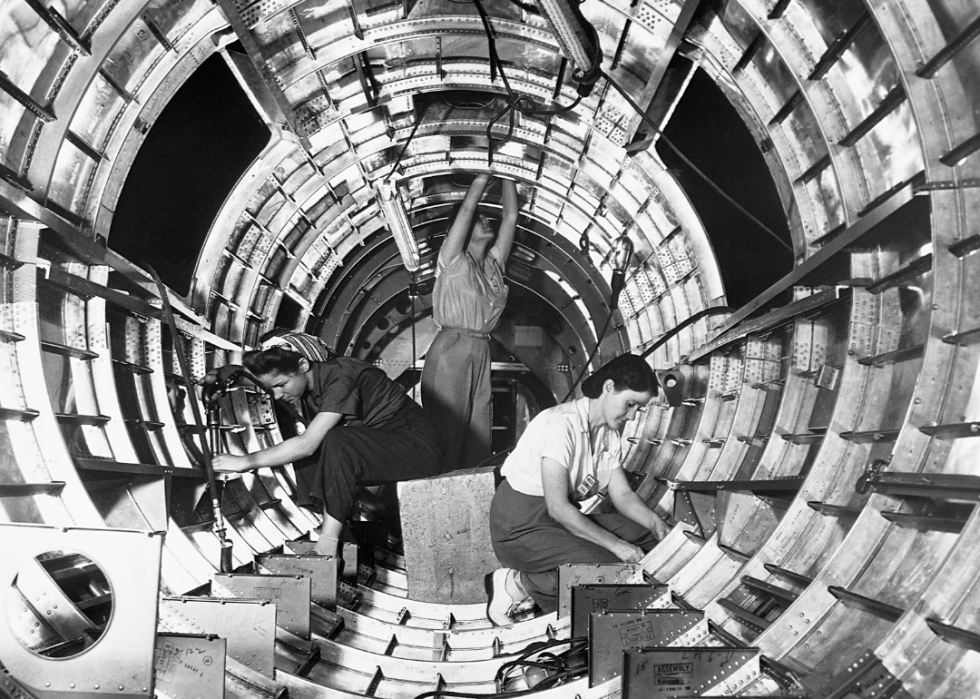
Circa 1940s: Women building a bomber
Women workers assemble the tail fuselage of a B-17F bomber, also known as a "Flying Fortress," at the Douglas Shipping Visitor in Long Beach, California. Millions of women worked in factories and volunteered for the Red Cross in social club to serve war efforts.
9 / 50
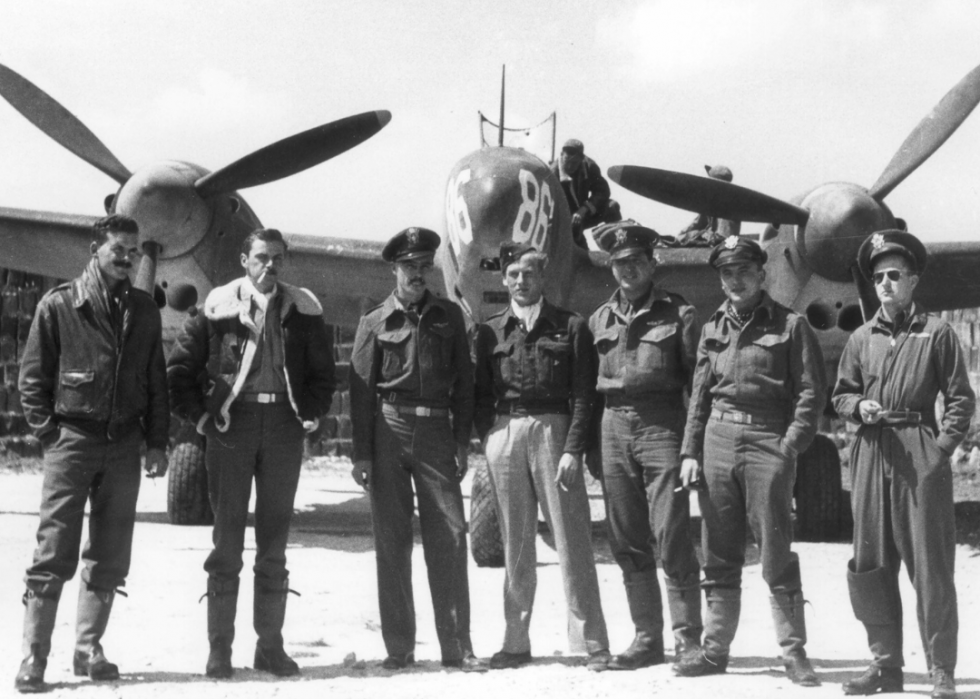
1943: Lockheed P-38 Lightning
Wing Commander Adrian Warburton DSO DFC (center) poses with the start United States Regular army Air Forces unit of measurement in Republic of malta. American pilots shown from left to right include: German, Spencer, Sculpone, Webb, Sugg, Bury. The United States endeavour involved over sixteen 1000000 servicemembers.
10 / 50
Hulton Archive // Getty Images
1943: Medal of laurels
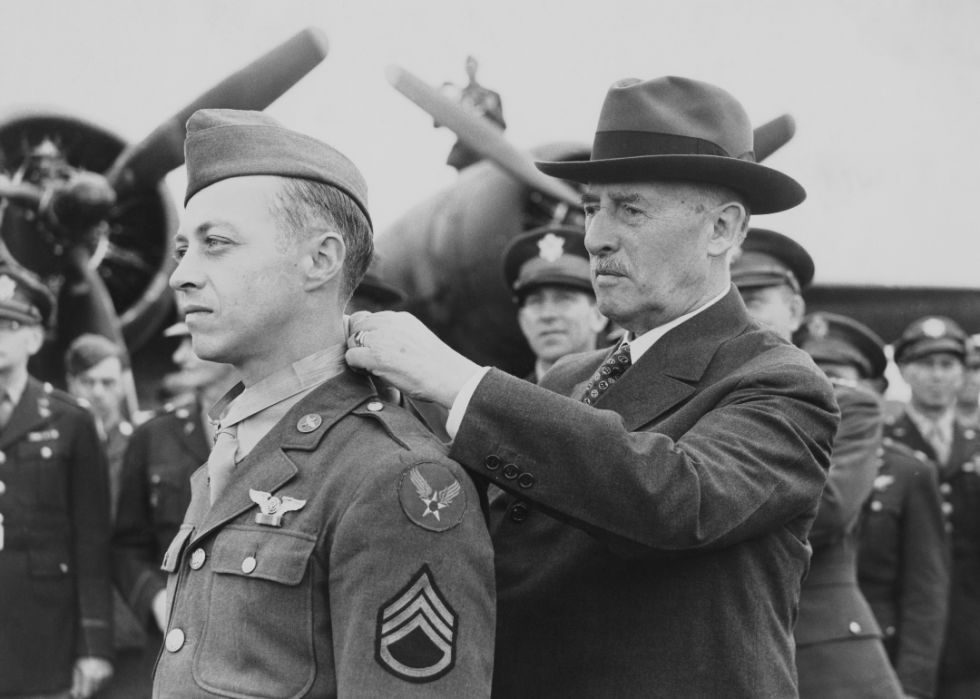
Staff Sergeant Maynard Harrison Smith of the United States Regular army Air Forces is decorated with the Congressional Medal of Honor by Henry L. Stimson, the U.S. Secretarial assistant of War, on July 16, 1943. Smith was recognized for his conduct as a gunner aboard a B-17 Flying Fortress bomber during Globe War II. The medal symbolizes the greatest honor given by the war machine and has been awarded 3,525 times.
Y'all may as well similar: Famous declassified regime secrets
11 / 50
Corbis Historical // Getty Images
1943: Sailor rescuing pilot from a airplane wreck
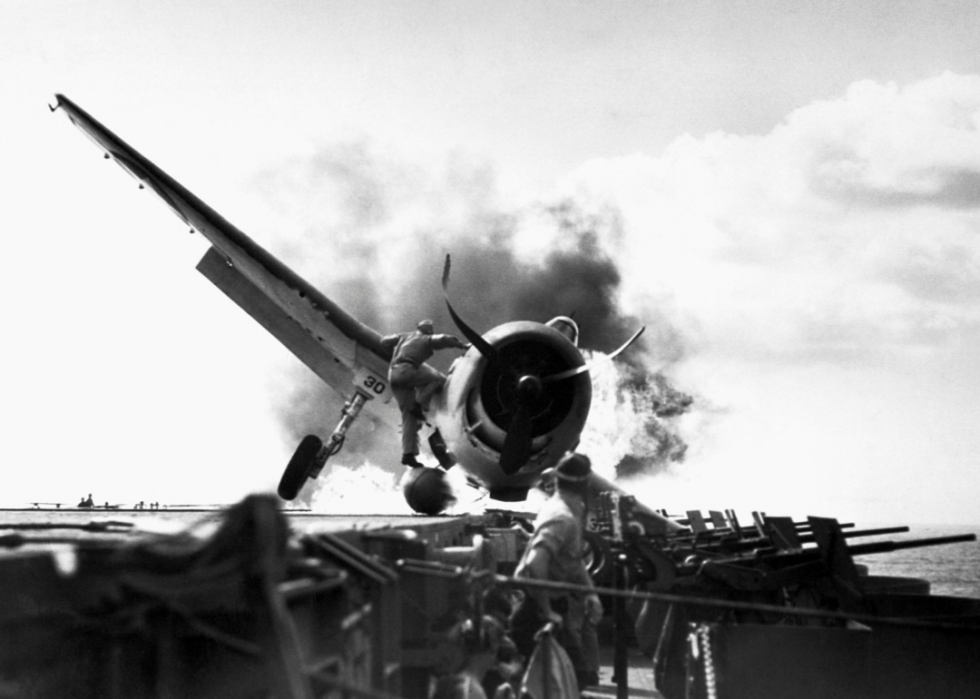
Lt. Walter Chewning, catapult officeholder aboard the UsaS. Enterprise, clambers upwardly the side of a downed F6F Hellcat to assist the pilot, Ensign Byron Johnson, from the flaming cockpit. The F6F Hellcat achieved a stunning nineteen:ane kill ratio during the war, showing the dominance of the technology and the incredible skill of the pilots.
12 / 50
Archive Photos // Getty Images
1944: Paratroopers preparing for D-Twenty-four hours
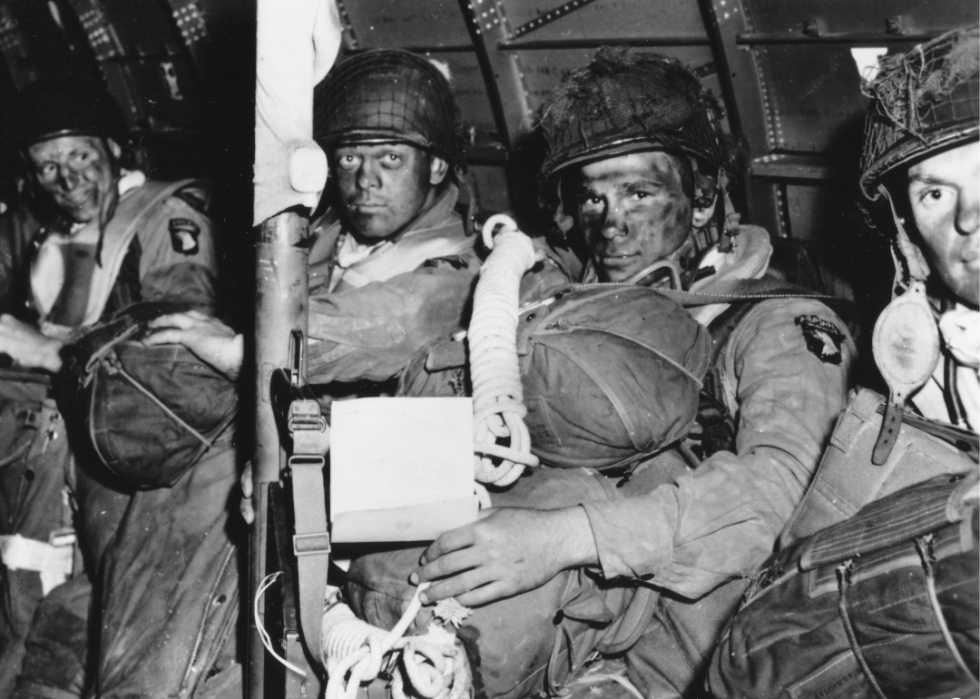
Resolute faces of paratroopers just before they took off for the initial assault of D-Mean solar day, June half-dozen, 1944. The paratrooper in the foreground has just read Full general Eisenhower'southward message of good luck and clasps his bazooka in the other hand. The assault on the beaches at Normandy included the largest airborne strength ever deployed up to that date.
13 / fifty
Archive Photos // Getty Images
1944: Operation Overlord
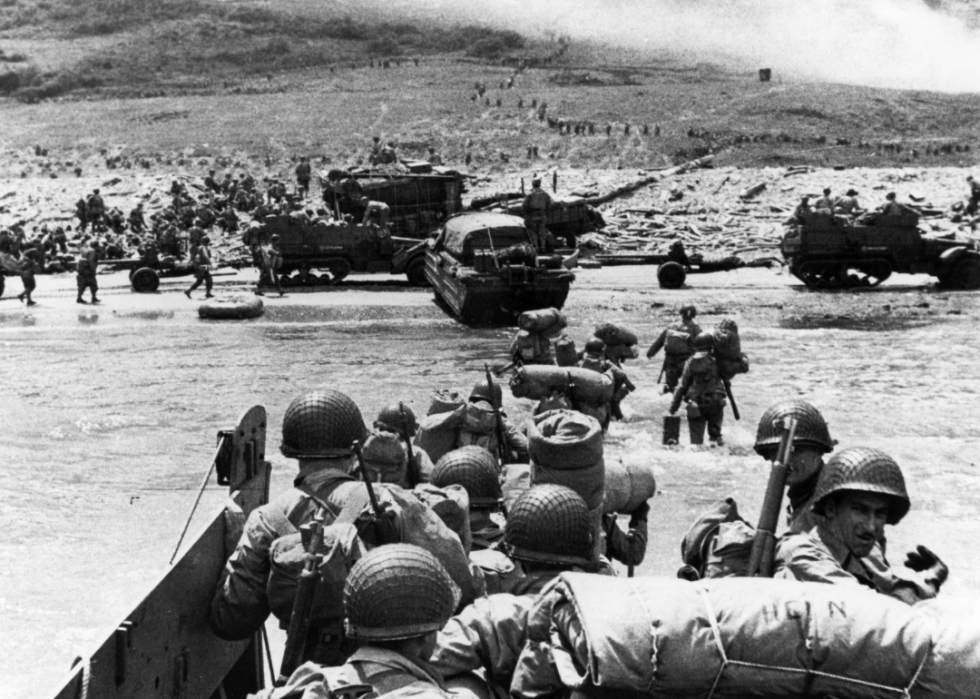
Pictured hither are American assault troops landing at Omaha Beach in Normandy supported by naval gunfire. The battles at Normandy, which paved the way for the invasion of Europe, involved about a quarter of a one thousand thousand casualties for the allied forces.
14 / 50
Archive Photos // Getty Images
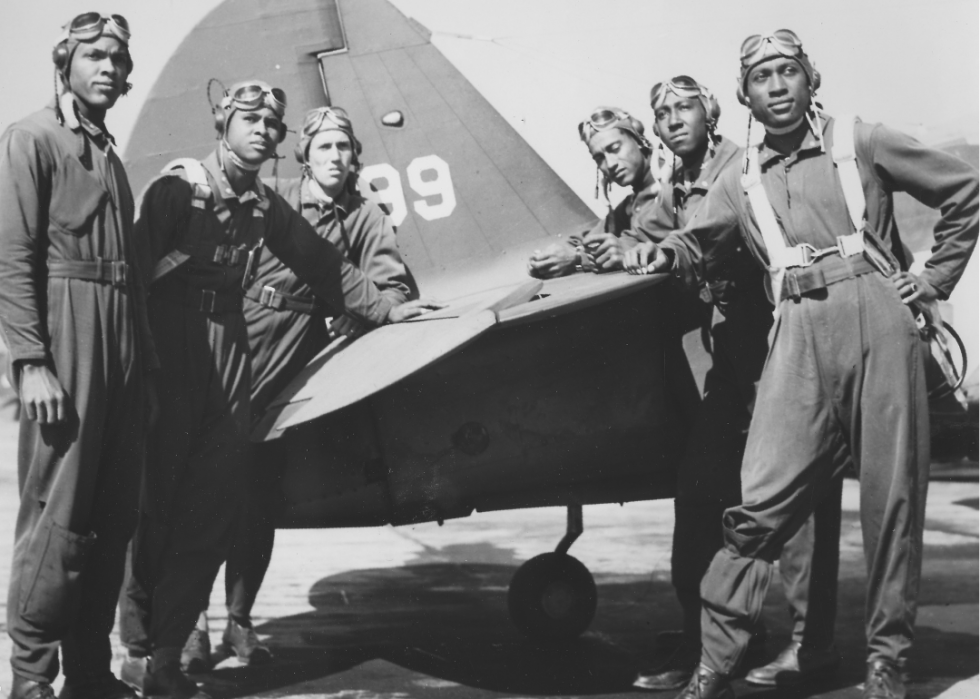
1944: Tuskegee Airmen
Tuskegee Airmen, with fighter aircraft, at Tuskegee Army Flying Schoolhouse during World War II, Tuskegee, Alabama, 1944. The success of these airmen helped in the breaking down of racial barriers in the state of war effort. They were known across Europe and Northern Africa for their heroism and bravery.
15 / 50
Archive Photos // Getty Images
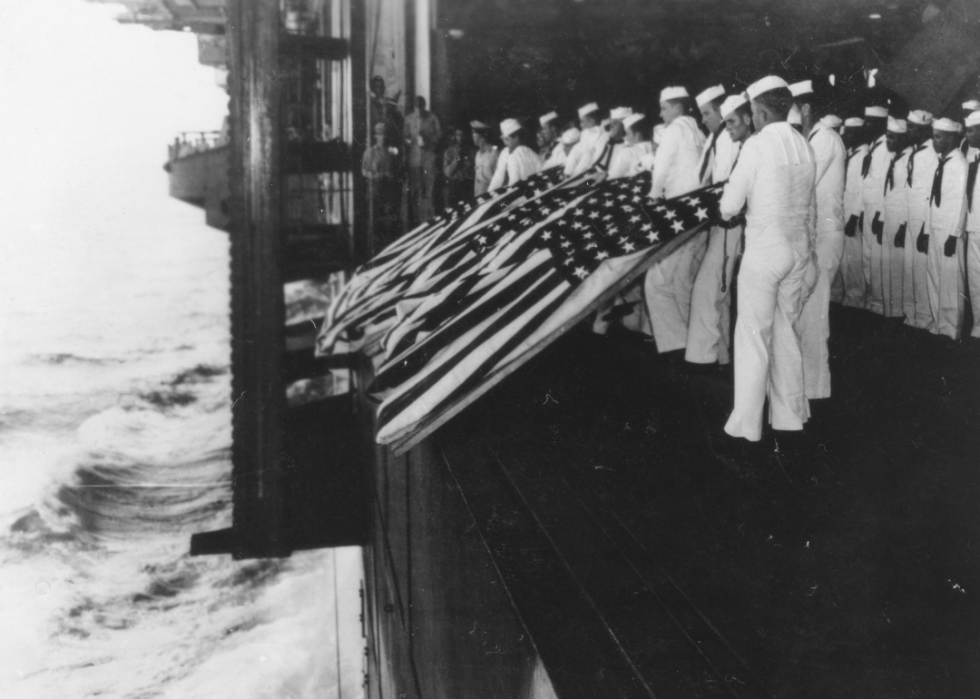
Circa 1940s: Burial at body of water for USS Intrepid casualties
16 / fifty
Hulton Annal // Getty Images
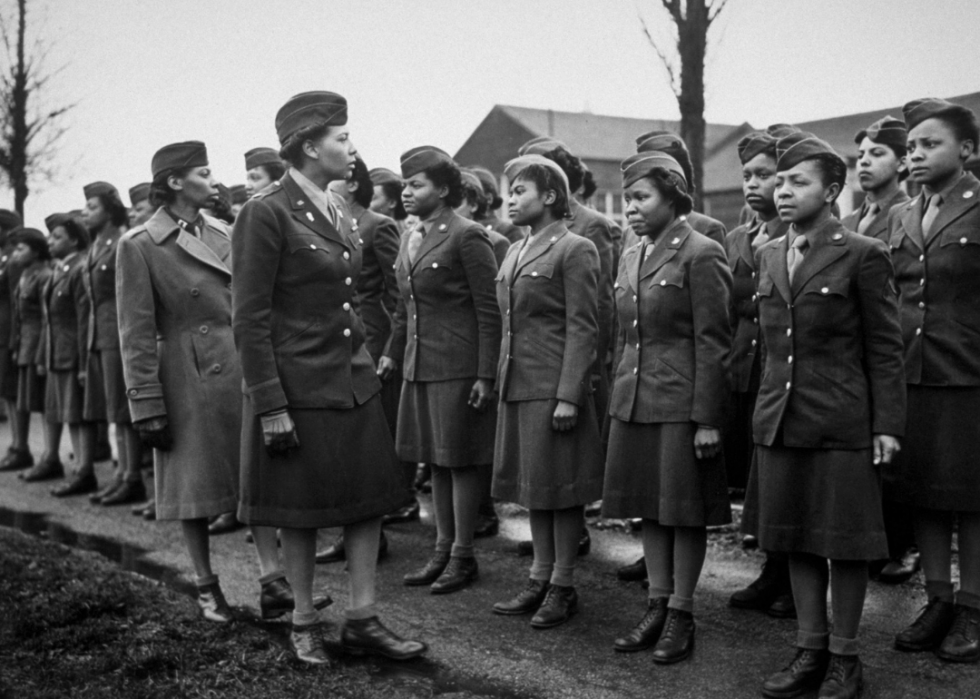
1945: Women's Ground forces Corp
A contingent of the Women'due south Regular army Corps from America existence addressed by Major Charity Adams. The group show was known every bit the Six Triple Viii and was the commencement group of Black women to exist deployed in Europe to sort mail service for troops overseas. Though thought to have been prepare up to fail, they ended up running the most efficient mail service in all of Europe during the war.
17 / 50
Universal Images Grouping // Getty Images
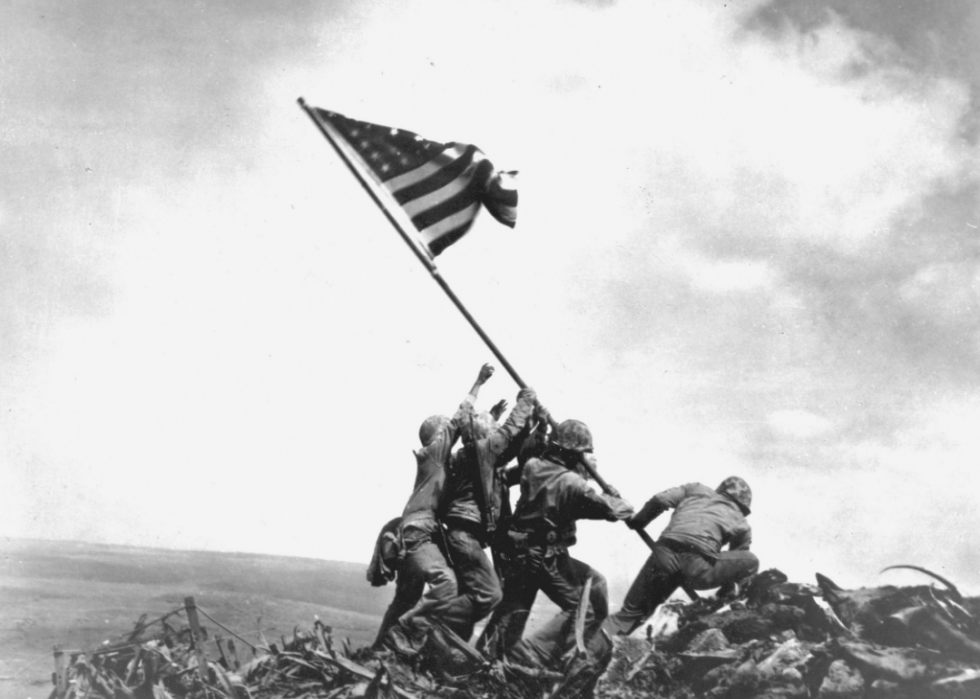
1945: Raising the flag on Iwo Jima
In 1 of the nearly iconic photographs in American military history, pictured here are members of the Us Marine Corps fifth Segmentation as they raise an American flag on Mount Suribachi during the Boxing of Iwo Jima. In 2019, the US Marine Corps positively identified the vi men pictured as Corporal Harlon Cake, Corporal Harold P. Keller, Individual Showtime Class Ira Hayes, Private Outset Class Harold Schultz, Private First Course Franklin Sousley, and Sergeant Michael Strank.
18 / 50
Historical // Getty Images
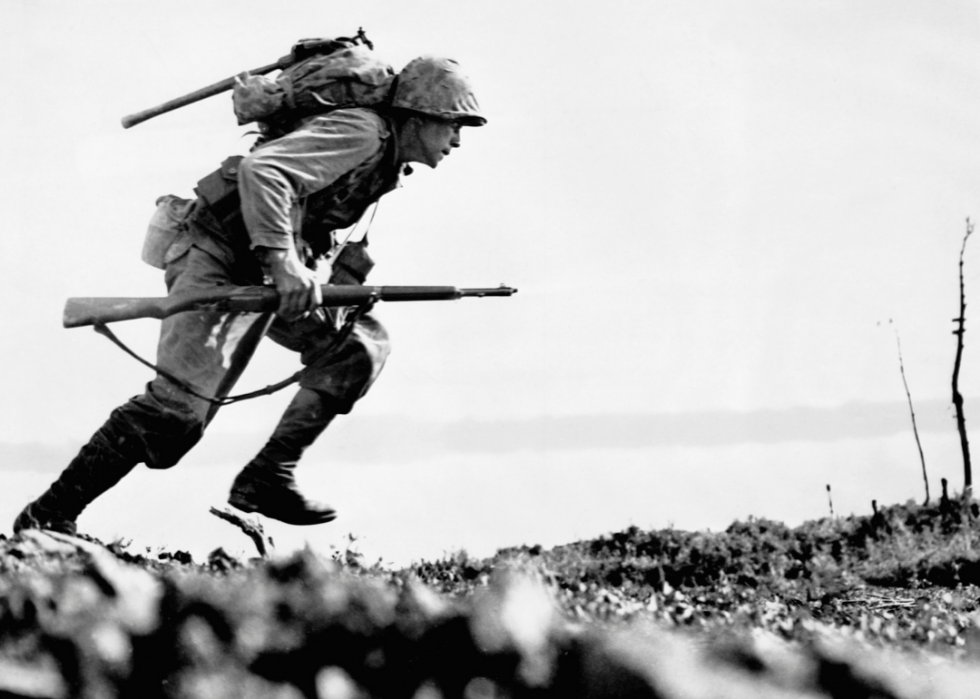
1945: Marine charging during Battle of Okinawa
A U.Southward. Marine charges frontward through Japanese car gun fire on Okinawa. Marines and infantry of the U.S. 10th Army controlled three-quarters of Okinawa iii weeks after landing on the island on March 31, 1945. The centrolineal invasion of Okinawa took three months and included ane,300 U.S. ships. More than 12,000 American servicemen from various branches of the armed forces perished in the fight to take the island.
19 / 50
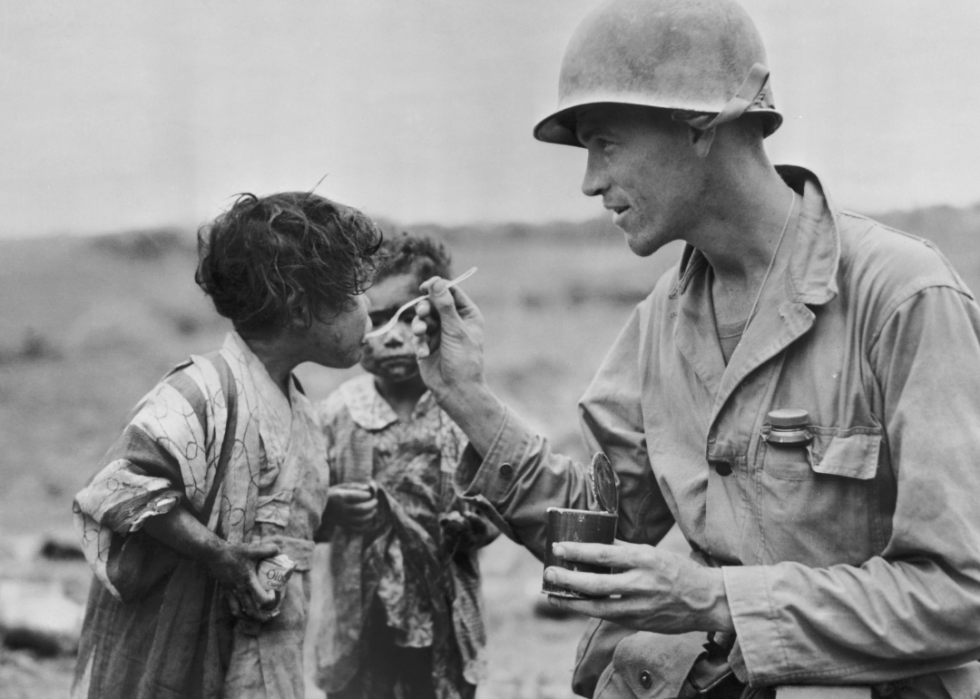
1945: Sharing nutrient
An American serviceman shares his rations with 2 Japanese children in Okinawa, Nihon, 1945. Shortly afterwards the centrolineal forces took command of the island of Okinawa, which was to be used as a base for an attack on mainland Nippon, the Japanese government gave in and offered an unconditional surrender.
xx / l
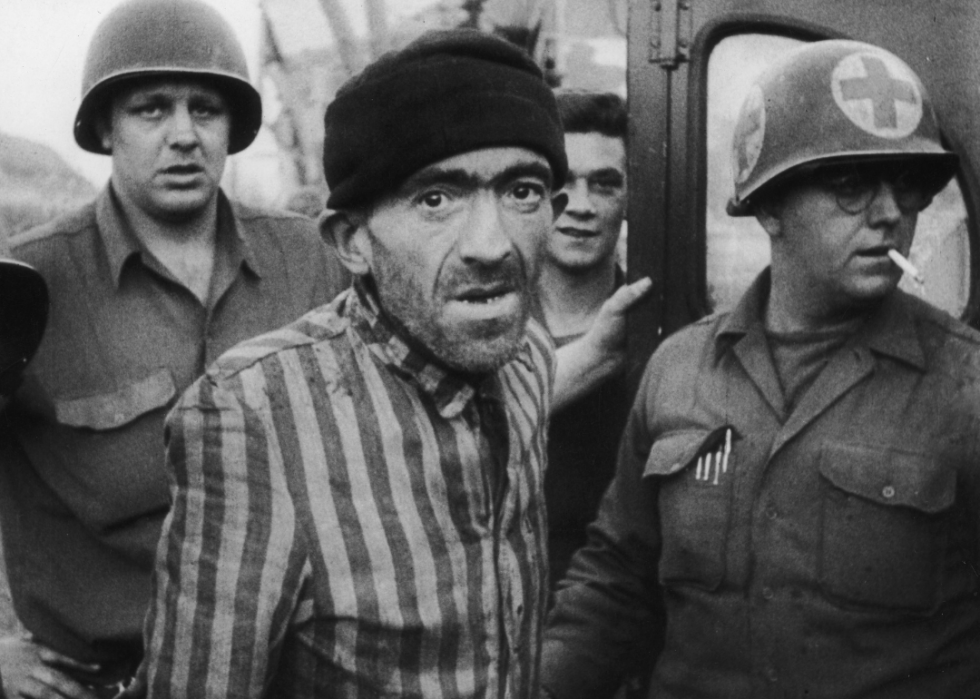
1945: Leaving Nordhausen
A survivor of the Mittelbau-Dora concentration camp at Nordhausen after the military camp was liberated by the U.South. Army, 1945. Information technology is unremarkably stated that over six million innocents were murdered by the Nazis during the Holocaust, though the true number may be well-nigh double that. The Nazis hid equally much of the evidence of their atrocities equally they could, and so the true number lost may never be known.
Y'all may as well like: Youngest heads of land in the world right at present
21 / 50
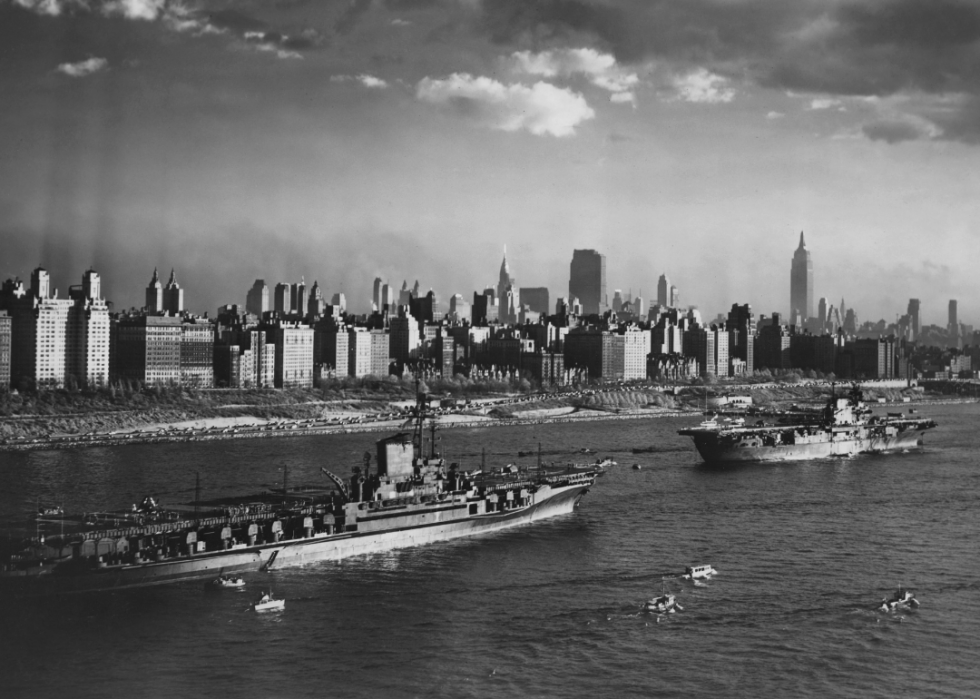
1945: Manhattan skyline
With the Empire State Edifice and the Manhattan skyline as a backdrop, the aircraft carriers USS Midway (CV-41) and the USS Enterprise (CV-six) of the United States Navy make their way to the post-Earth War Ii Navy Mean solar day review by President Truman on October. 27, 1945, in Manhattan, New York. Over sixteen million Americans served in the war effort.
22 / 50
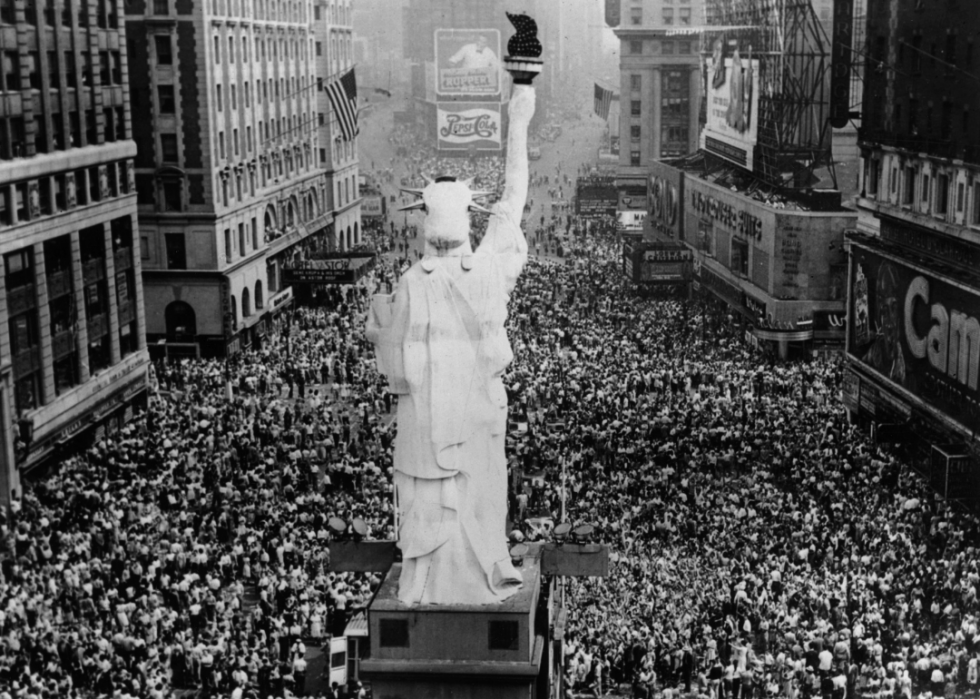
1945: Nippon surrenders
Following the German surrender in May, the state of war officially ended on Sept. ii, 1945. Shown here are crowds cheering on Slap-up White Way, New York Metropolis, as President Truman announces the formal signing of the Japanese Instrument of Give up. A scaled-down version of the Statue of Liberty is in the foreground.
23 / 50
Hulton Annal // Getty Images
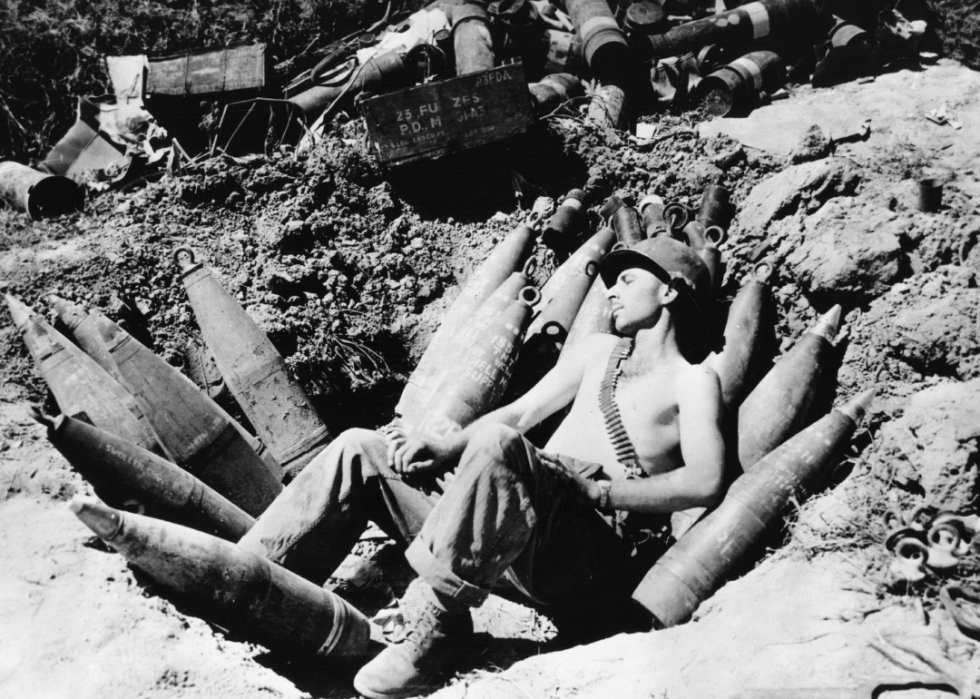
Circa 1950: Bed of shells
An American soldier is pictured hither sleeping on his ammunition in the Mason area during the Korean war. The war began in 1950 with the invasion of South korea by North Korea and ended in 1953, though the Korean peninsula is however divided to this day.
24 / 50
Fundamental Printing // Getty Images
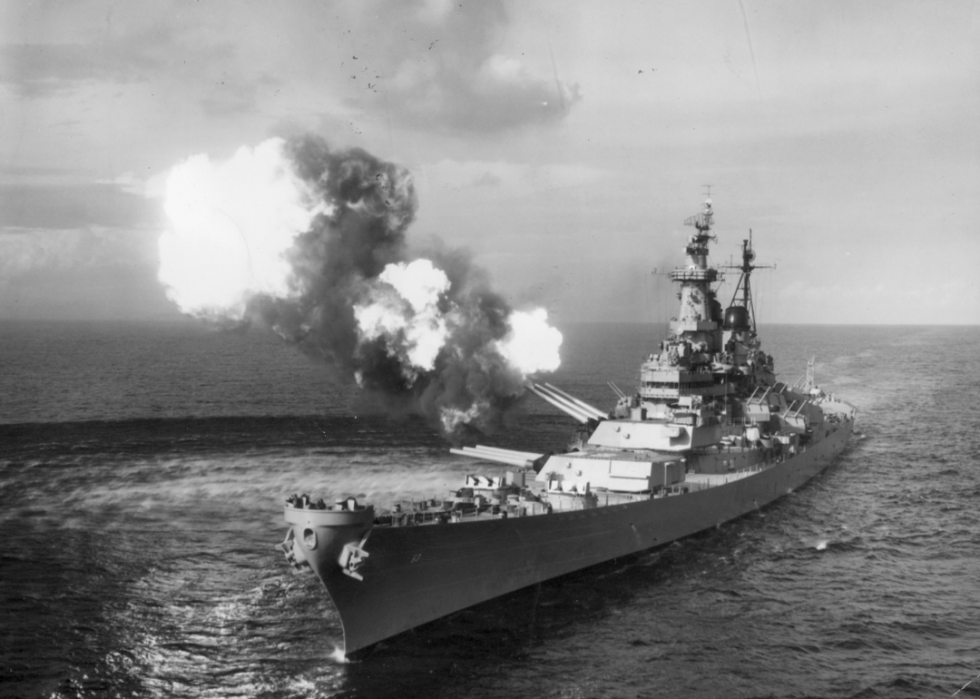
1951: The Mighty Mo
The battleship USS Missouri bombards Chongjin, Democratic people's republic of korea, with her sixteen-inch guns during a mission to set out the lines of communication between the northern and southern parts of Korea during the Korean War. Chongjin is very close to the Soviet border and the Russian naval base of operations at Vladivostok. Although millions of fighters perished during the war, the Korean War is known as "the forgotten war."
25 / 50
Historical // Getty Images
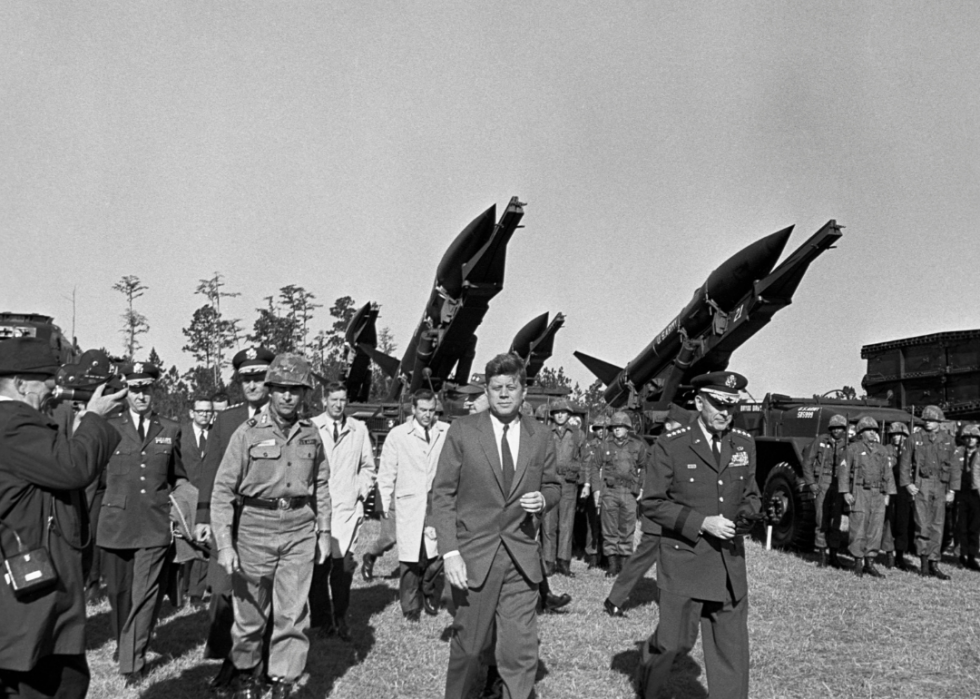
1962: Kennedy and military leaders
President Kennedy meets with U.S. Army officials during the Cuban Missile Crisis of Oct to November 1962. The crisis lasted only a matter of weeks, and was perhaps the closest the The states and the USSR came to using nuclear weapons during the Cold War.
You may as well like: l endangered species that only live in the Amazon rainforest
26 / 50
Hulton Annal // Getty Images
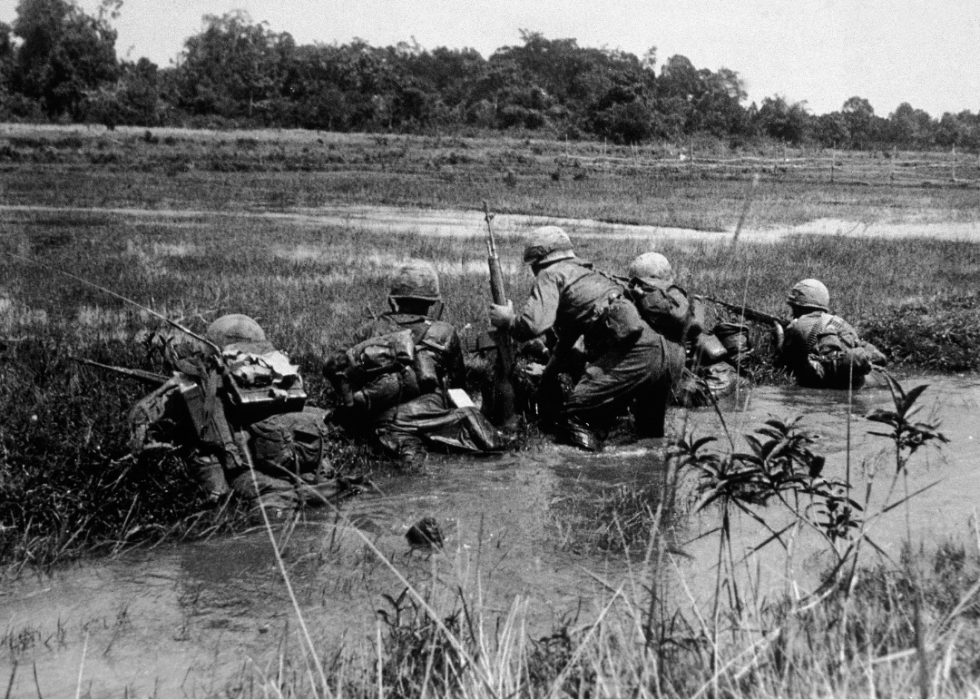
1965: Usa combat unit in vietnam
U.South. Army combat platoon leader Second Lieutenant John Libs (heart) of second platoon, C Visitor, 2d Battalion, 16th Infantry Regiment, 1st Division, surveys the state of affairs with his men from the relative safety of a watery rice paddy, as they fix to advance on a Viet Cong sniper position. Libs and the rest of 2nd Platoon participated in the boxing of Xa Cam My/Operation Abilene in April 1966, during which Charlie Company suffered 82% casualties.
27 / 50
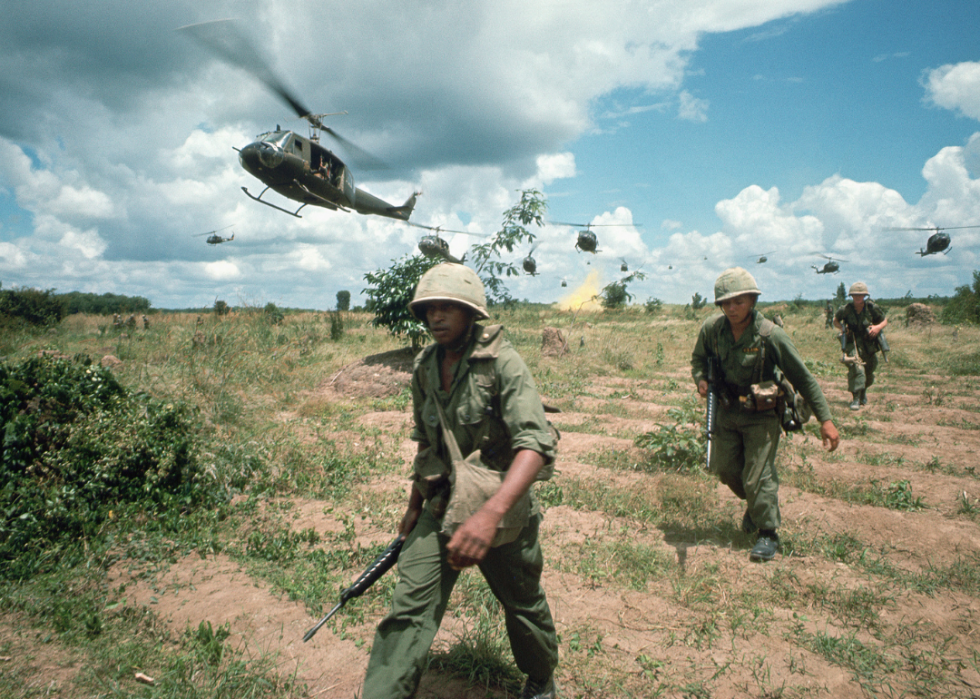
1965: US infantry
The U.Due south. 173rd Airborne are supported past helicopters during the Iron Triangle assail. The Iron Triangle was a strategic stronghold for the North Vietnamese and remained and then until the stop of the war. The United States involved over 3 1000000 service members in the conflict, which spanned xix years.
28 / 50
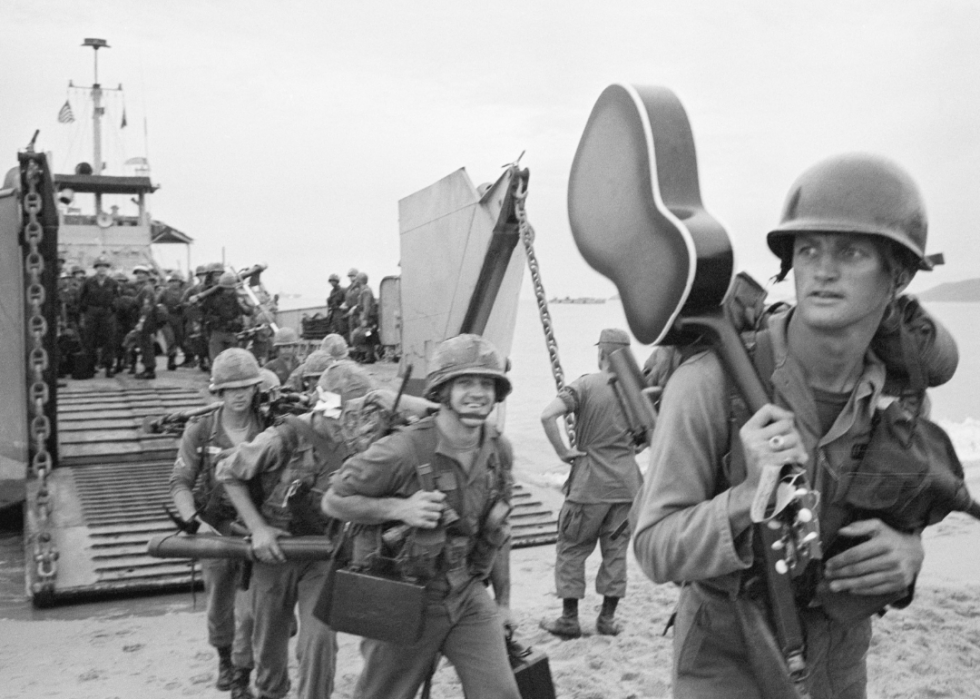
1965: American soldiers arriving in Vietnam
Guitar slung over his shoulder, a trooper of the United states of america 1st Cavalry walks ashore from a landing arts and crafts. More than ii,500 cavalrymen arrived here, bringing the total of the Army's Get-go Airmobile Division up to sixteen,000 men. Over the following two years, the amount of U.S. troops deployed in Vietnam totaled 500,000.
29 / fifty
U.South. Ground forces // Getty Images
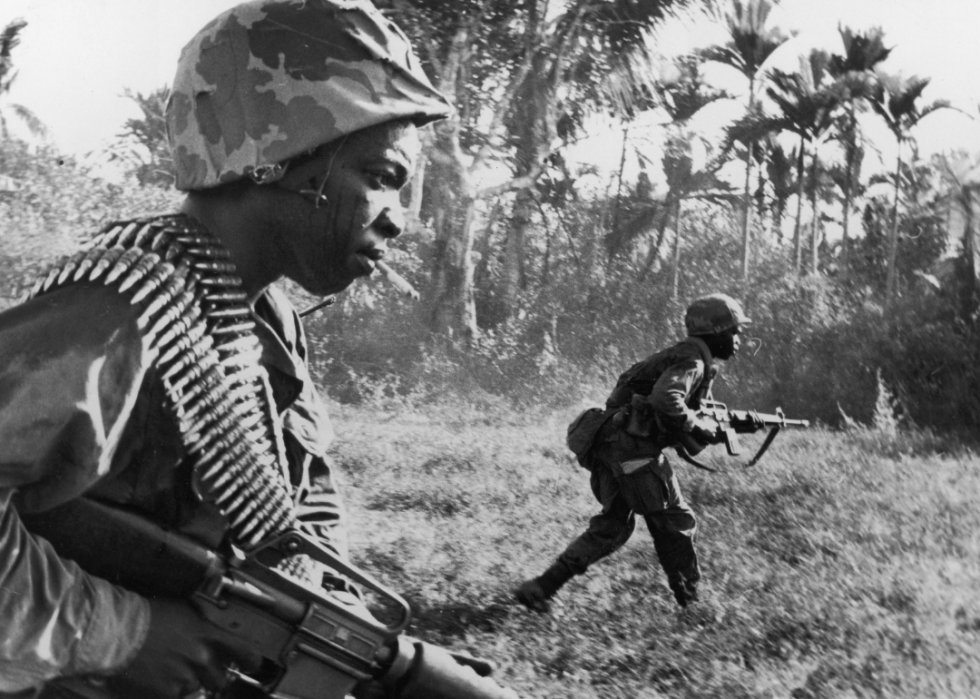
1967: United states of america Army rifleman charge viet cong
U.Southward. riflemen from the 173rd Airborne Brigade charge toward Viet Cong positions, holding machine guns in a wooded area of War Zone D during the Vietnam War. Massive protests against the war efforts, and the involvement of the United States, were spreading back home while the soldiers fought abroad.
30 / 50
1967: Soldiers engaged in long crawl to crest
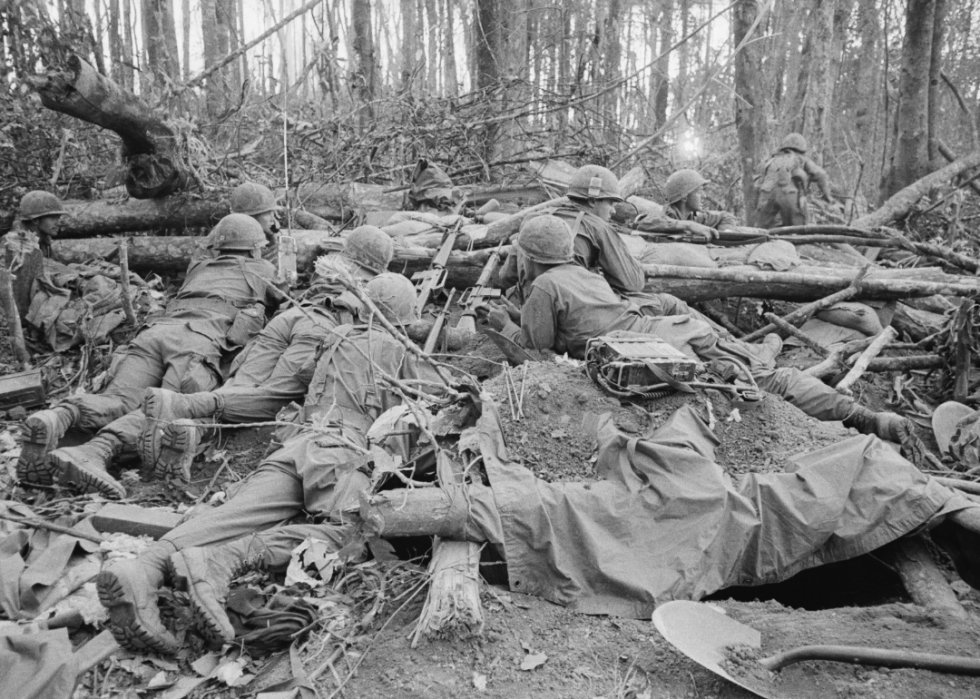
Members of the 173rd Airborne Brigade are engaged in a long, long crawl to the crest of Colina 875, a steep mound that in four days toll American forces some of their highest casualties of the war. Pushing inch-by-inch of sloping globe behind them, U.S. paratroopers seized about of the hill on Nov. 22. They were then faced with a Northward Vietnamese stronghold atop the acme and reports of two fresh regiments of NVA troops moving into the region.
You may also similar: States with the highest and everyman Trump approval ratings
31 / l
1968: Soldier shaving colleague'southward head
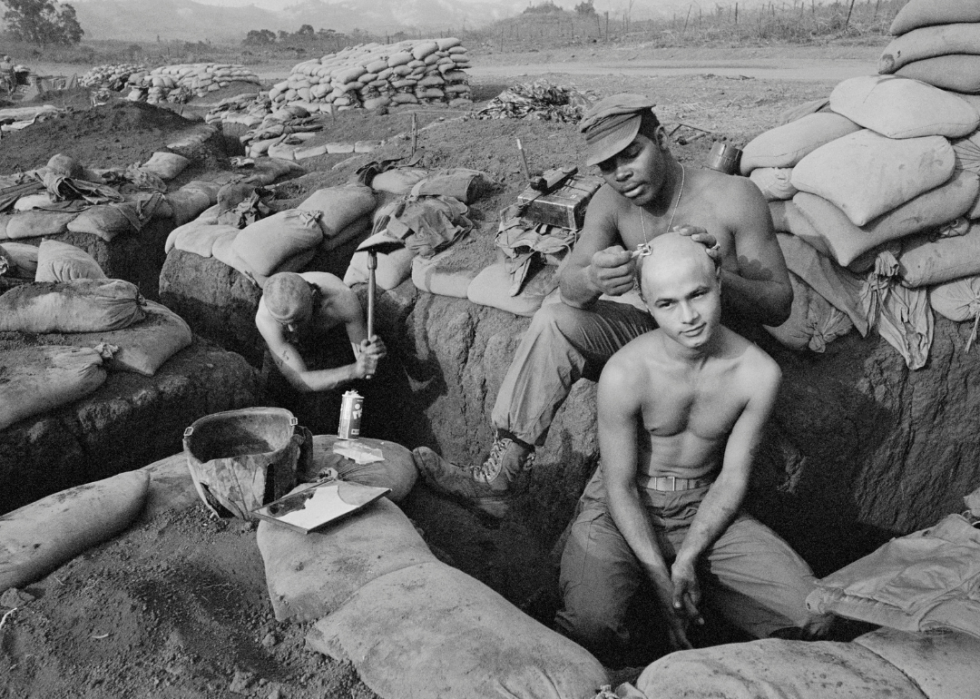
Hairstylist service was a rarity at the embattled Marine bastion of Khe Sanh, so Marine PFC Robert DuBois of Brooklyn, New York, did the honors for a buddy and shaves the head of Cpl. Efrain Torres of New York outside their bunker. Scores of Communist troops moving toward the Marines fortress were killed in napalm and bombing attacks by Allied shipping.
32 / 50
Terry Fincher // Getty Images
1968: Hill Timothy
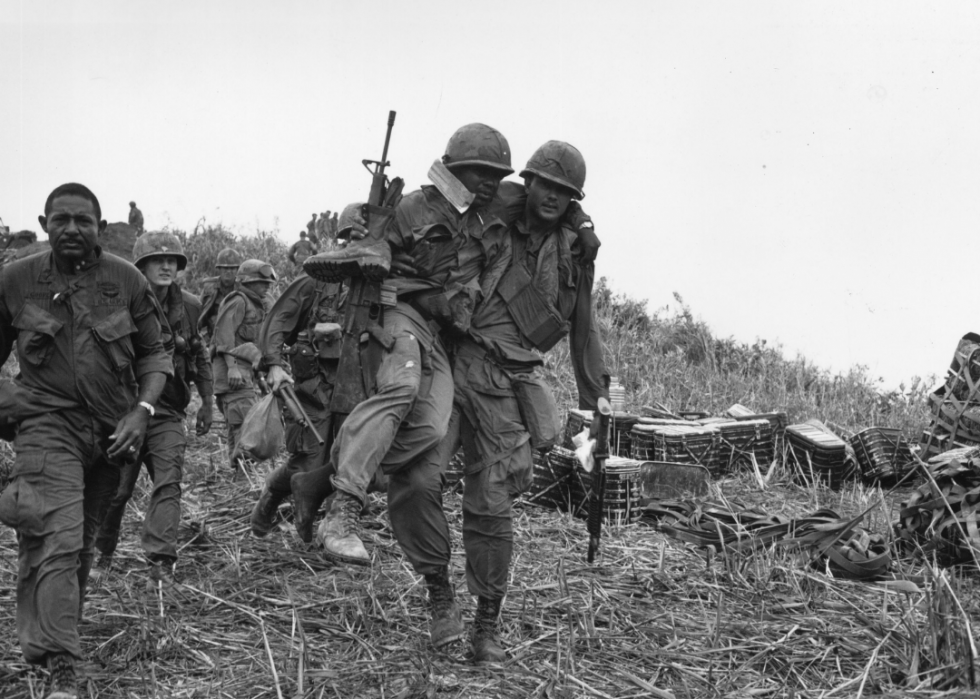
U.Due south. soldiers, one wounded and being carried past a colleague, walking down Loma Timothy during the conflict in Vietnam. About 60,000 Americans died in Vietnam. The unconventional ways of fighting, and the noesis the Vietnamese had almost their own terrain, led to the United states of america removing troops without completing their objectives.
33 / 50
U.S. Navy // Getty Images
1969: Naval patrol arts and crafts
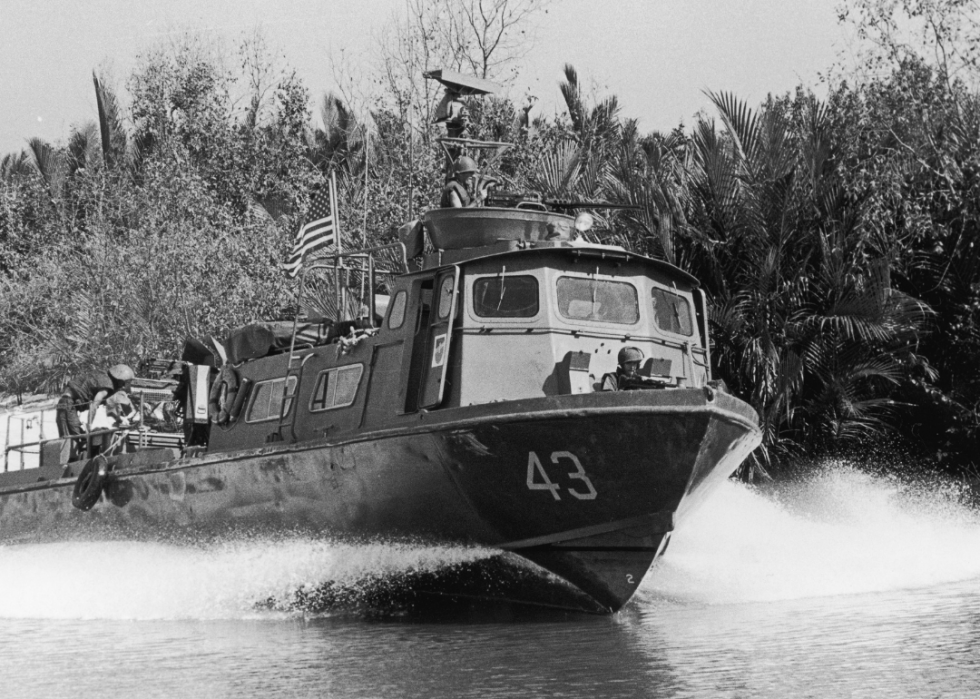
The states Navy inshore patrol craft (PCF) 43 cruises along a riverbank in the Republic of Vietnam during Operation Slingshot in the Vietnam State of war. Patrol boats like this one were used to transport troops and secure areas forth the Mekong Delta in Vietnam.
34 / 50
Dirck Halstead // Getty Images
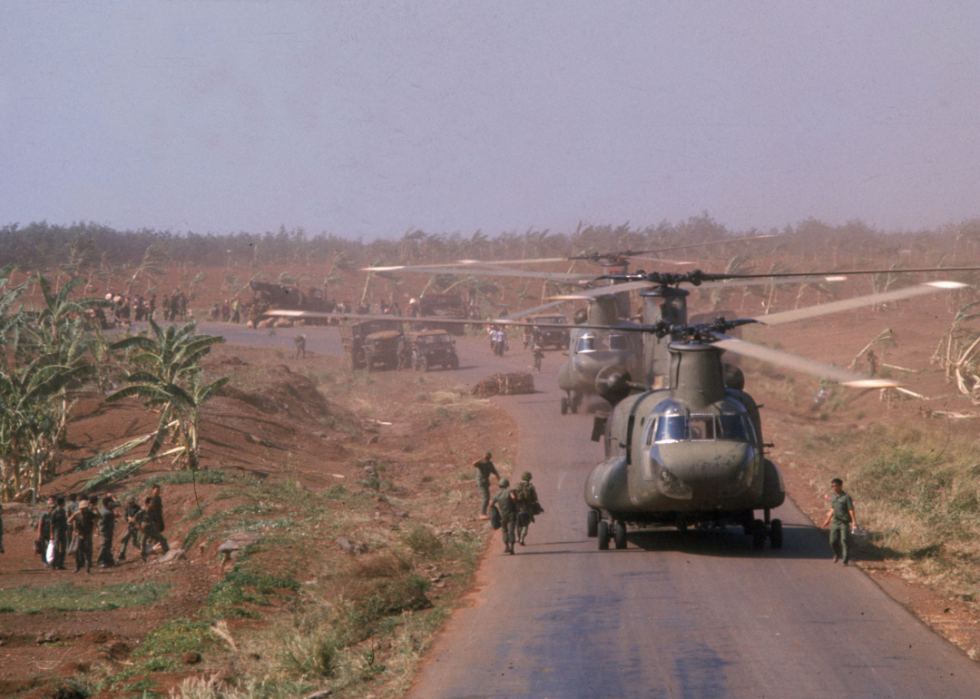
1975: The fall of Saigon
American military Chinook helicopters helping with the evacuation of Saigon in Apr 1975. America'due south interest in the Vietnam War ended as troops from communist Northward Vietnam invaded Saigon, the upper-case letter of the Republic of Vietnam in the South. Chinook Helicopters first saw battle in the Vietnam State of war, and were known for their speed and power to behave large numbers of people.
35 / 50
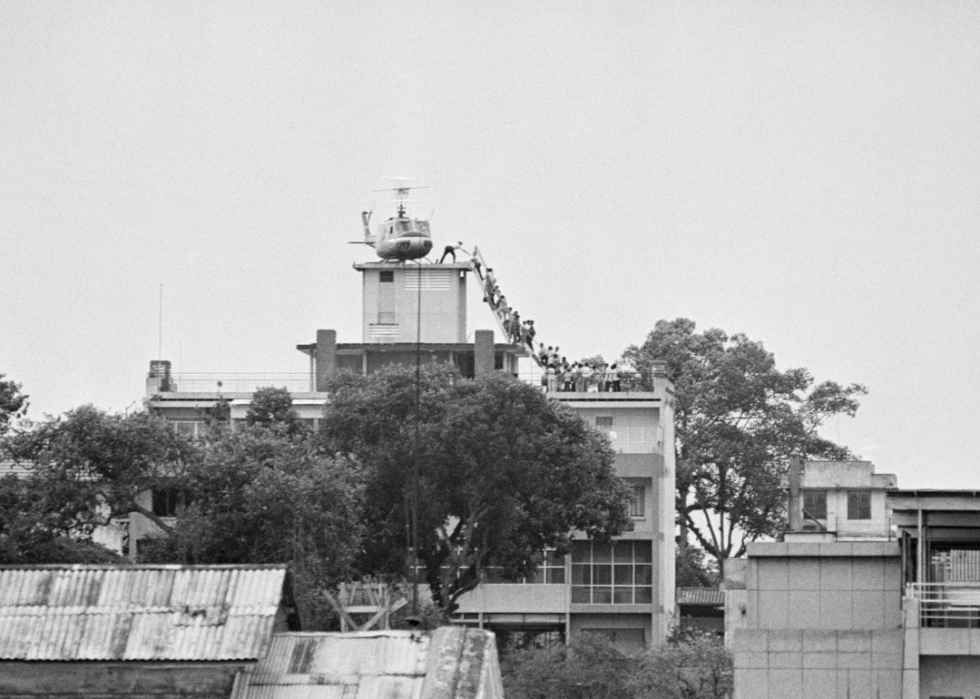
1975: Evacuation
A CIA employee (thought to be O.B. Harnage) helps Vietnamese evacuees onto an Air America helicopter from the acme of 22 Gia Long Street, a one-half-mile from the U.S. Embassy. The fall came two years later on the Paris Peace accords, which saw the U.S. leave the conflict. This moment is also known equally the "Liberation of Saigon."
Y'all may also like: Most and least pop senators in America
36 / 50
Steven D Starr // Getty Images
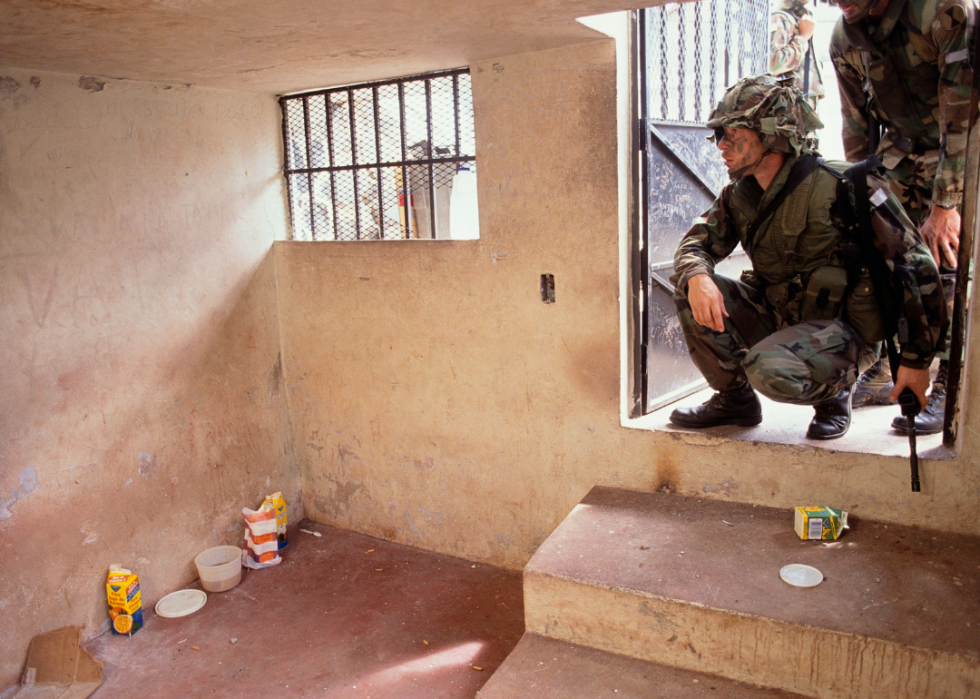
1989: Usa soldiers await into a prison prison cell
American soldiers look within a surreptitious police force prison jail cell during the invasion of Panama. The U.s. invaded Panama in 1989 to bring leader Manuel Noriega back to the U.S. to face up charges of racketeering, drug trafficking, and money laundering while making mode for the rising of the democratically elected leader, Guillermo Endara.
37 / 50
Tom Stoddart Archive // Getty Images
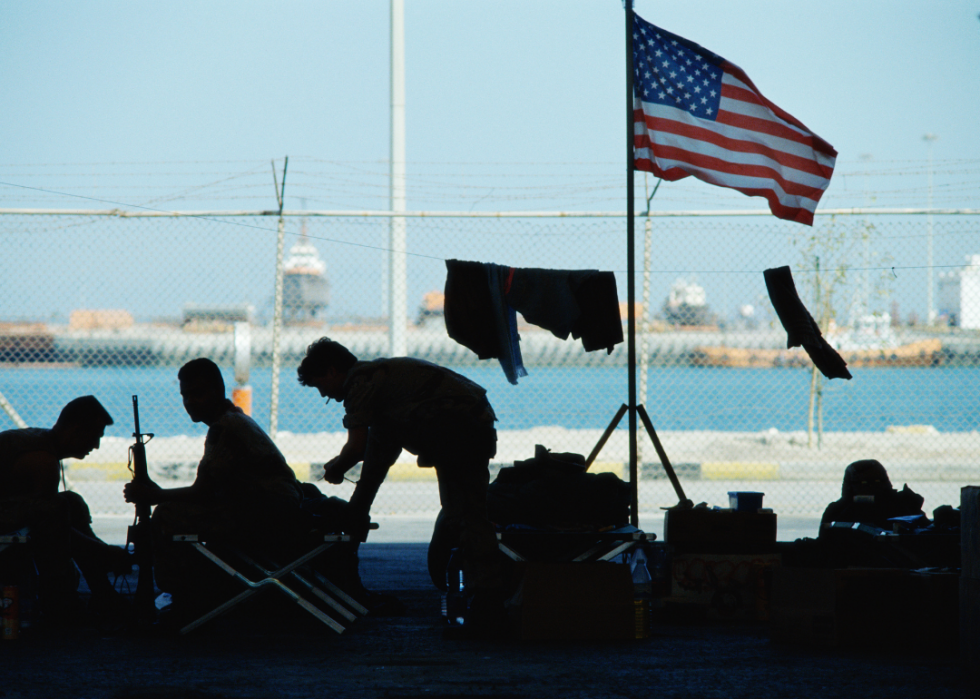
1990: Operation Desert Shield
U.S. Marines make camp beside the Stars and Stripes in Dhahran, Saudi arabia, during the Gulf War in December 1990. Performance Desert Shield began after the invasion of Kuwait by Saddam Hussein. The operation turned into Operation Desert Storm when efforts at diplomatic resolution failed.
38 / fifty
Tom Stoddart Archive // Getty Images
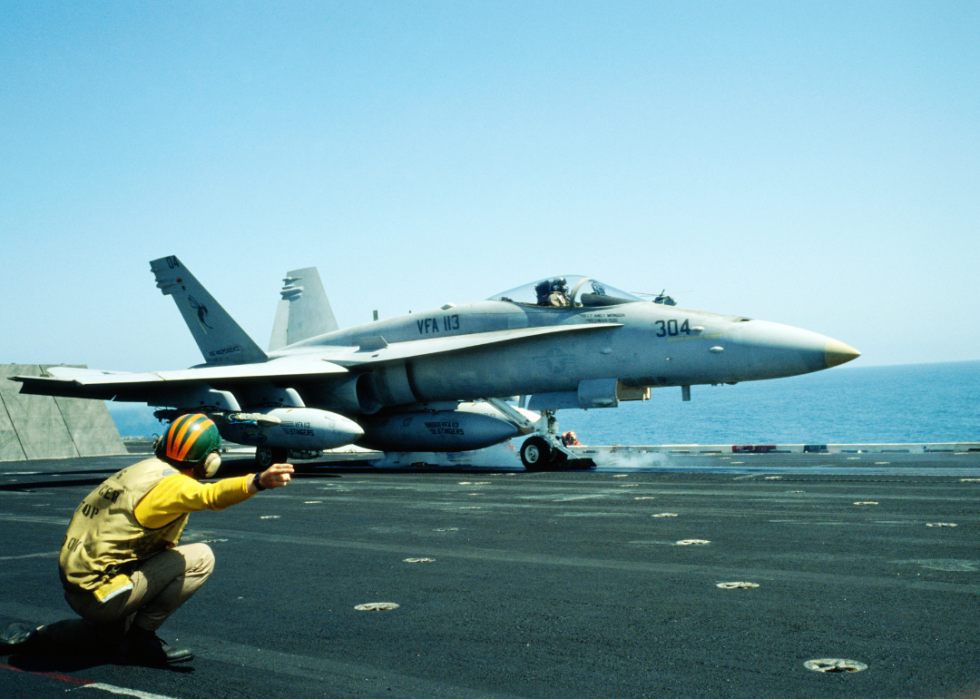
1990: Persian Gulf War
Deck crew and an F-fifteen aircraft from the tactical fighter wing taking off from the aircraft carrier USS Independence in Dhahran, Kingdom of saudi arabia, to bear out a mission over Kuwait during the Gulf State of war in December 1990. Operation Desert Storm involved the largest use of United states military aircraft since the war in Vietnam. The U.S. and its allies dropped over eighty,000 bombs during the offensive.
39 / 50
Mike Nelson // Getty Images
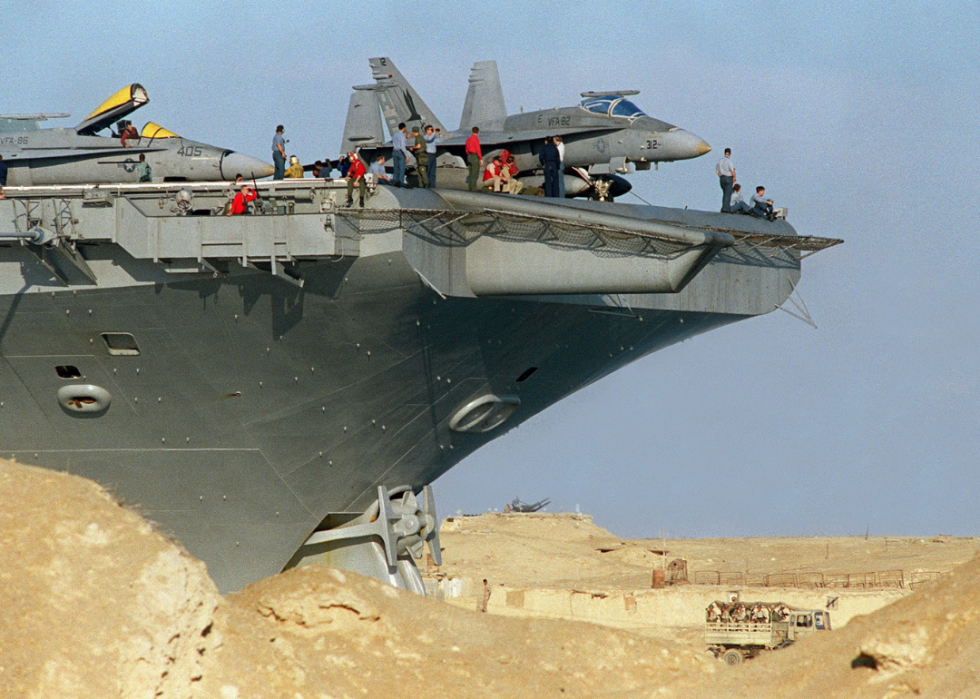
1991: USS America
The bow of the shipping carrier USS America looms in a higher place the sand dunes forth the Suez Canal on Jan. 15, 1991, as an Egyptian army truck and anti-shipping position baby-sit the strategic waterway. USS America is shown here making its style towards the Cherry Sea to be on alert in the Iraq-Kuwait conflict.
xl / 50
Patrick Durand // Getty Images
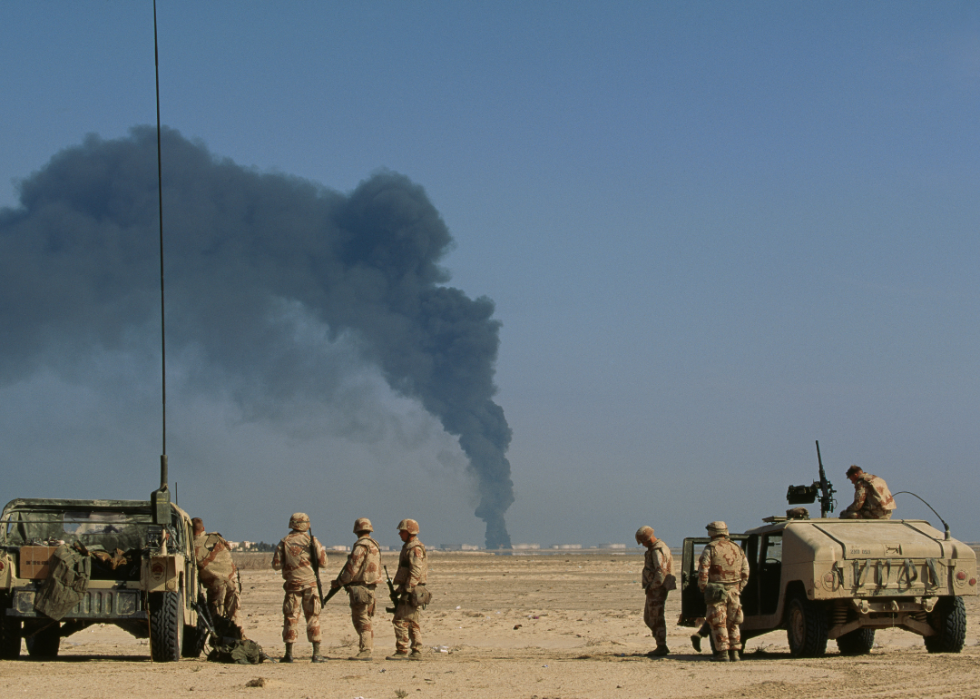
1991: US soldiers watch oil refinery burn
41 / 50
David Turnley // Getty Images
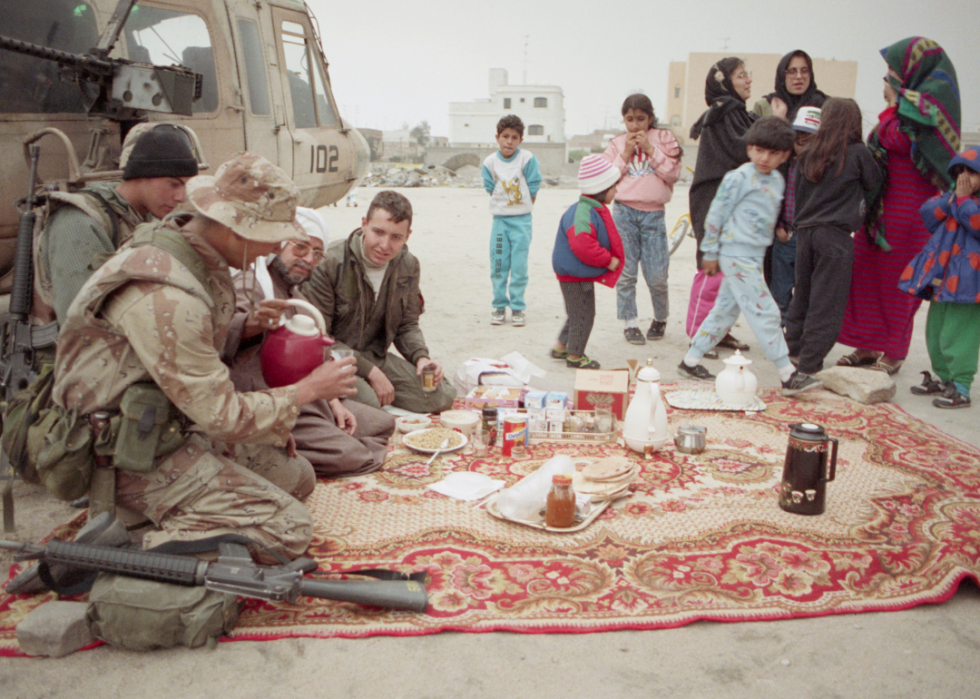
1991: Kuwaitis with American soldiers
American soldiers have tea with Kuwait citizens during Functioning Desert Storm. Americans accept connected to exist viewed favorably past Kuwaiti citizens, and the ii nations accept maintained strong diplomatic ties since the end of the Gulf War concluded in 1991.
42 / l
Pool BASSIGNAC/HIRES/MERILLON // Getty Images
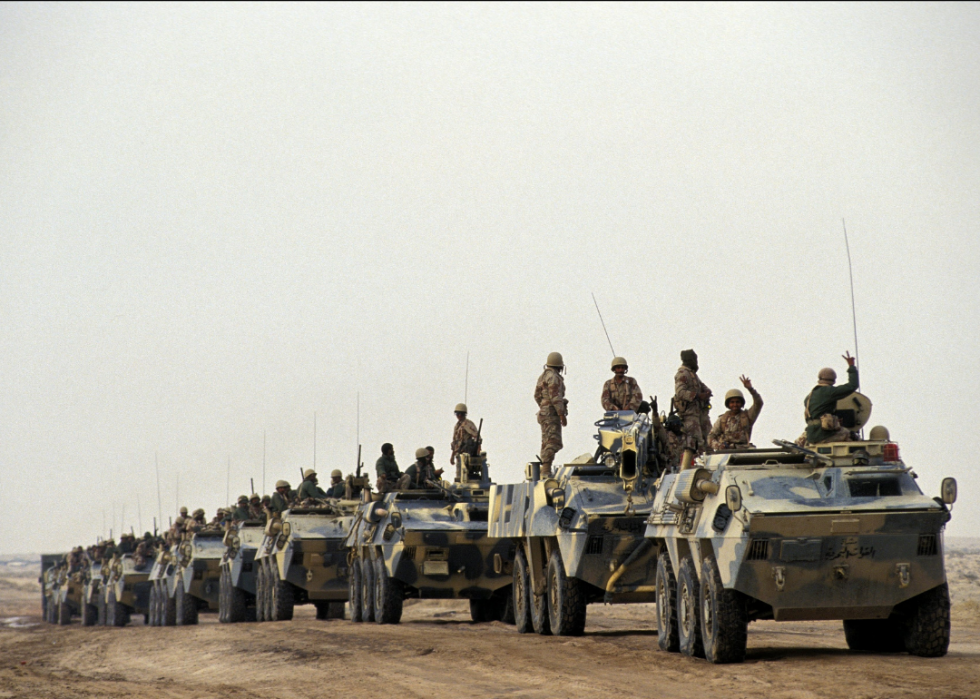
1991: The border Kow in Saudi arabia
Once the offensive confronting Iraqi leader Saddam Hussein began, it didn't final long. Inside a unmarried twenty-four hour period, the United States and its allies controlled the airspace in the region. Hussein fired airstrikes at strategic positions in Kingdom of saudi arabia in response. The Un passed a armistice on March two, which included sanctions and a requirement to pay for damages inflicted during the state of war.
43 / l
Wathiq Khuzaie // Getty Images
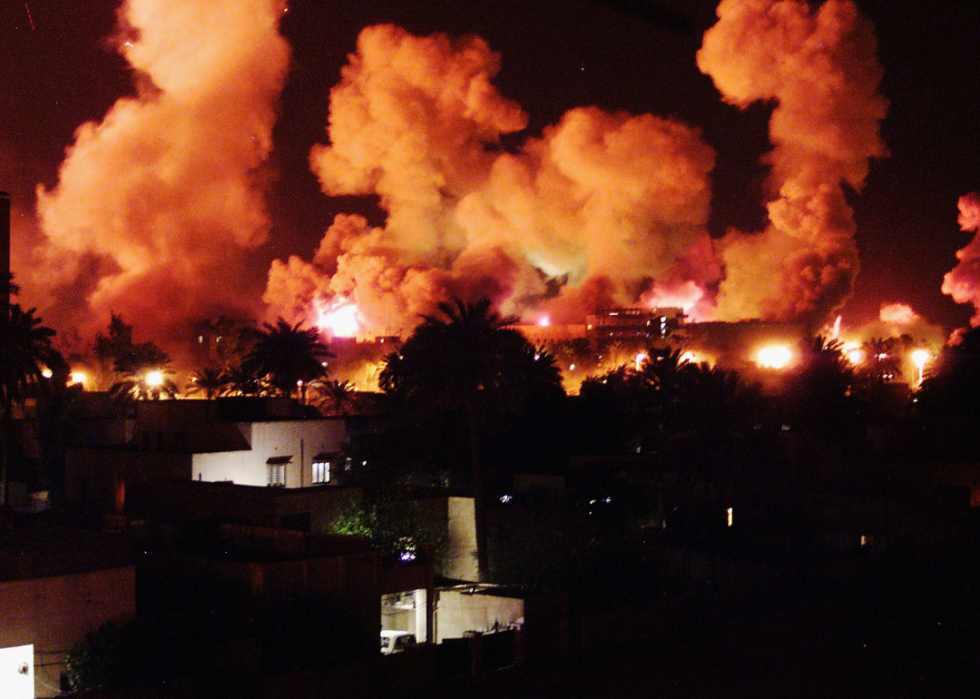
2003: Daze and awe
Smoke rises from explosions during the first few minutes of a massive air attack on March 21, 2003, in Baghdad, Republic of iraq. Though Iraqi President Saddam Hussein was captured after that year, combat missions in Iraq wouldn't stop until 2011. The conflict left over 30,000 civilians dead.
44 / 50
Mario Tama // Getty Images
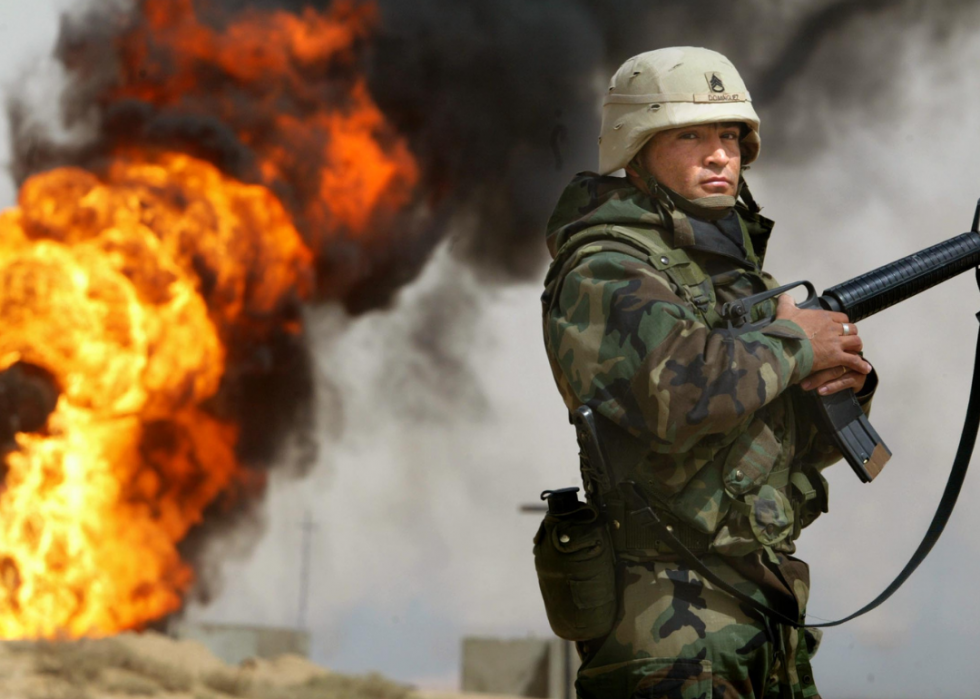
2003: Oil fires burn in Iraq
U.S. Army Staff Sergeant Robert Dominguez, of Mathis, Texas, stands baby-sit next to a burning oil well at the Rumayla oil fields in Rumayla, Iraq. Several oil wells were set ablaze by retreating Iraqi troops in the Ramayla surface area, the 2d largest offshore oilfield in the country, near the Kuwaiti border.
45 / l
Mike Theiler // Getty Images
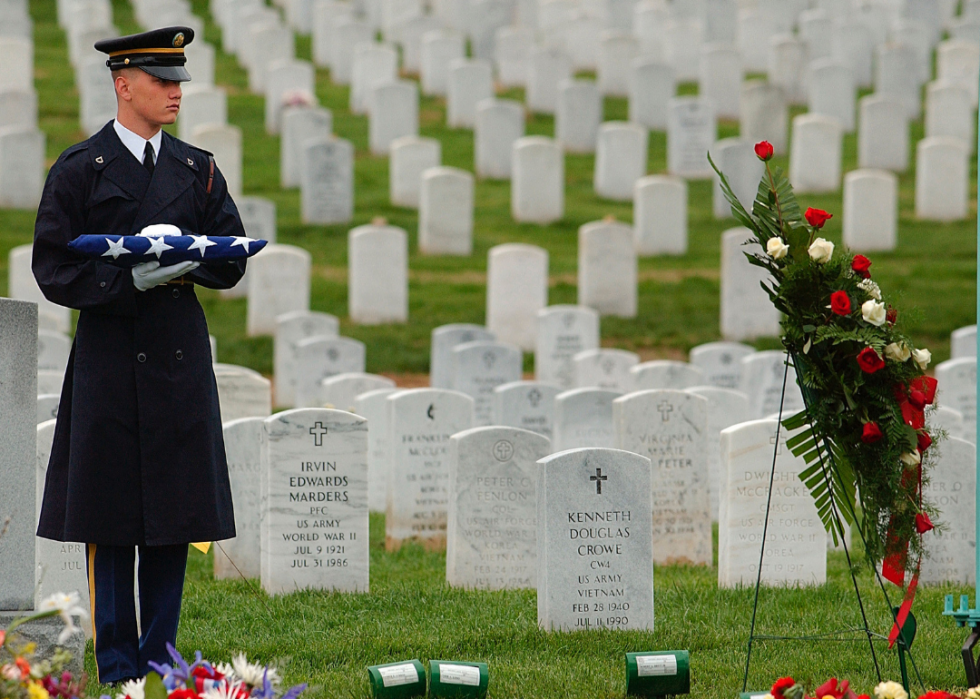
2003: Families mourn soldiers killed during war with Iraq
A member of an honor guard holds an American flag equally he waits for the funeral of U.S. Army Sergeant First Form Wilbert Davis at Arlington National Cemetery April eighteen, 2003, in Arlington, Virginia. Davis was killed on April 3, 2003, in a vehicle accident in Iraq, forth with announcer Michael Kelly. Suicide bombers and improvised explosive devices (IEDs) caused numerous deaths during the war.
You may also like: Iconic buildings that were demolished
46 / 50
Wathiq Khuzaie // Getty Images
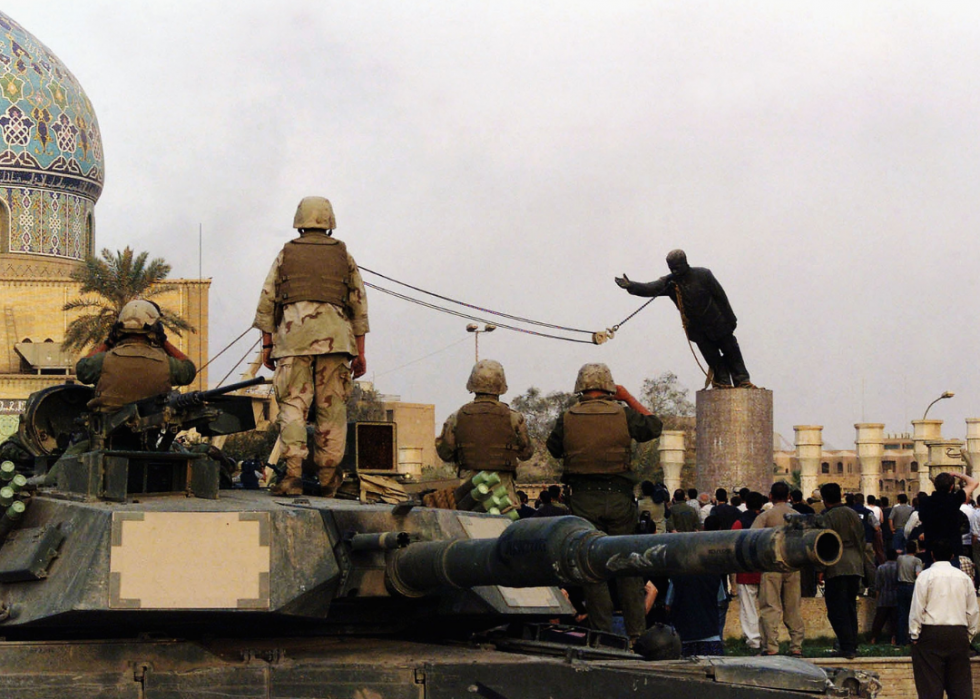
2003: The fall of Baghdad
U.Due south marines and Iraqis are seen on Apr ix, 2003, as the statue of Iraqi dictator Saddam Hussein is toppled at Al-Fardous Square in Baghdad, Iraq. After the fall of Baghdad, and the arrest of Hussein, the people of Republic of iraq participated in democratic elections to install new leadership for the land.
47 / 50
David McNew // Getty Images
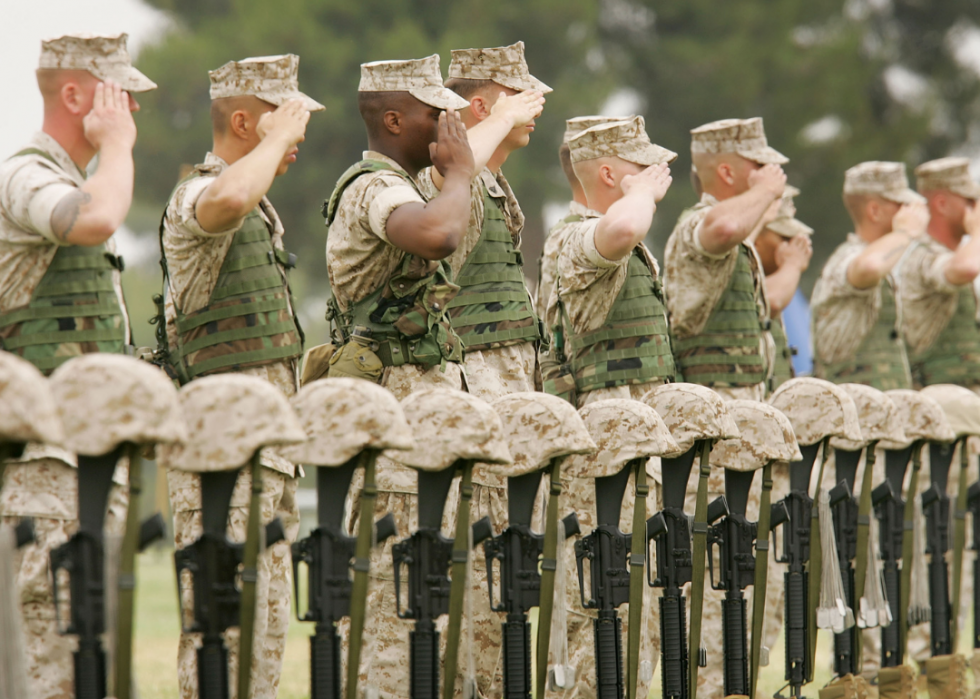
2005: 1st Marine division honors comrades killed in Iraq
U.S. Marines at Military camp Pendleton, California, salute behind memorials to their fallen comrades, at a service memorializing the 420 soldiers, sailors, Marines, and British soldiers who lost their lives while serving with the 1st Marine Division in support of Performance Iraqi Freedom. The 1st Marine Segmentation had recently completed a year-long deployment to Iraq, serving in the Al Anbar Province from March 2004 until March 2005.
48 / 50
David McNew // Getty Images
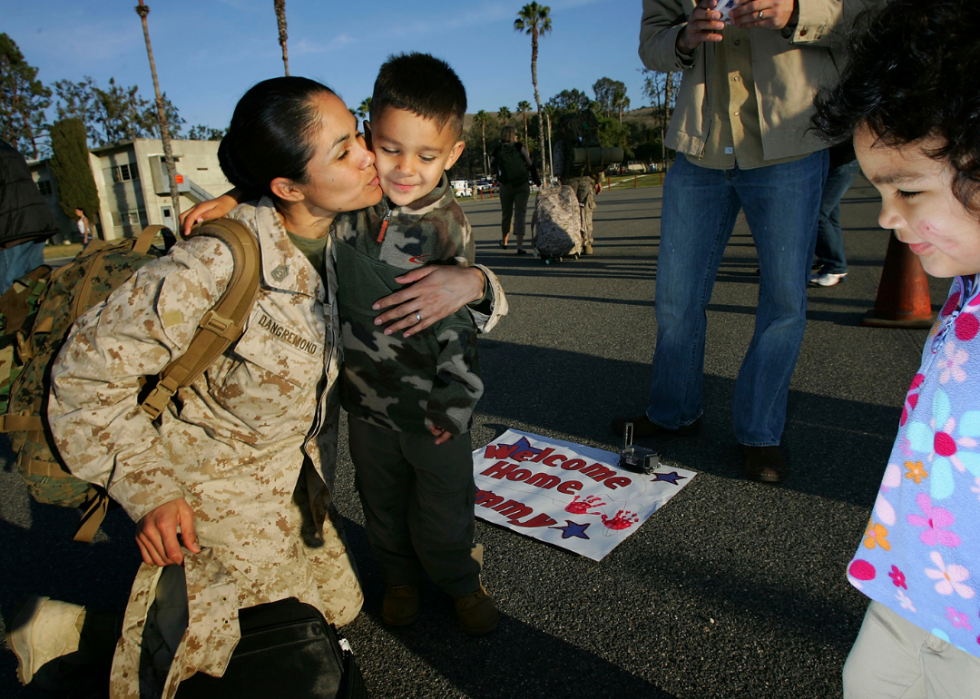
2006: Marines return subsequently 1 year deployment to Iraq
Gunnery Sergeant Deborah Dangremond kisses her son Tyler, 4, every bit her daughter Basia, 3, looks on. Marines and sailors of the 1st Marine Logistics Group (MLG) were returning home from a 12-month deployment to Iraq on Feb. 2, 2006, at Military camp Pendleton, California. The 1st MLG provided logistical support to the ground fighters, such equally maintenance, supply, medical care, and other necessary elements of daily being in a combat zone to keep the fighters on the frontlines.
49 / l
John Moore // Getty Images
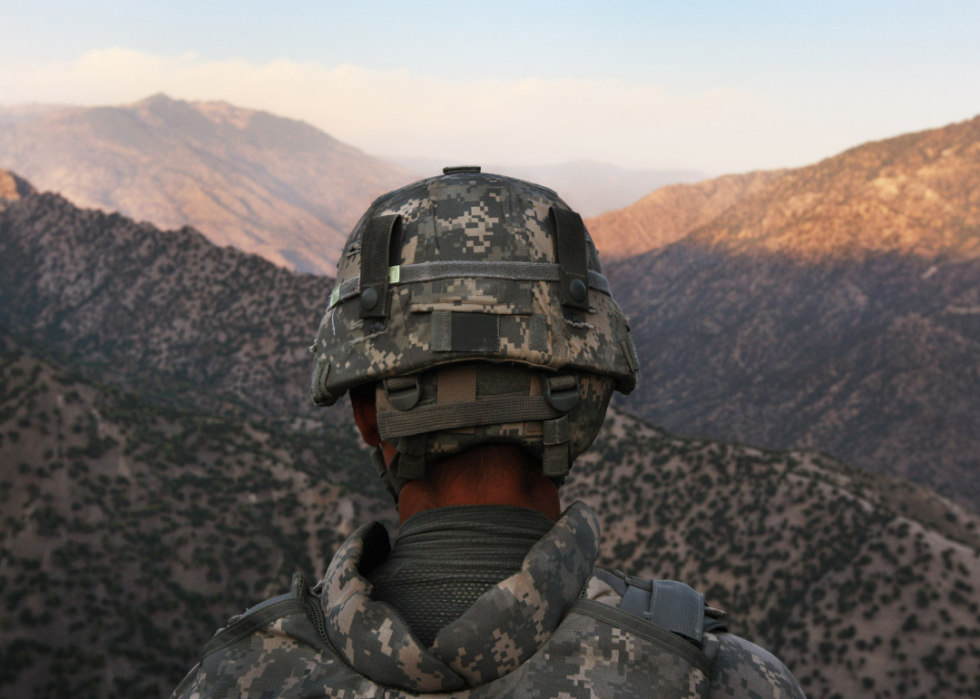
2008: U.s. Army battles Taliban in Kunar Province
U.S. Regular army Start Lieutenant Matthew Hernandez looks down the Korengal Valley from a mountaintop outpost on Oct. 24, 2008, in the Kunar Province of eastern Afghanistan. The remote and isolated area was the site of some of the heaviest fighting between U.S. forces and Taliban insurgents.
50 / fifty
Andrew Renneisen // Getty Images
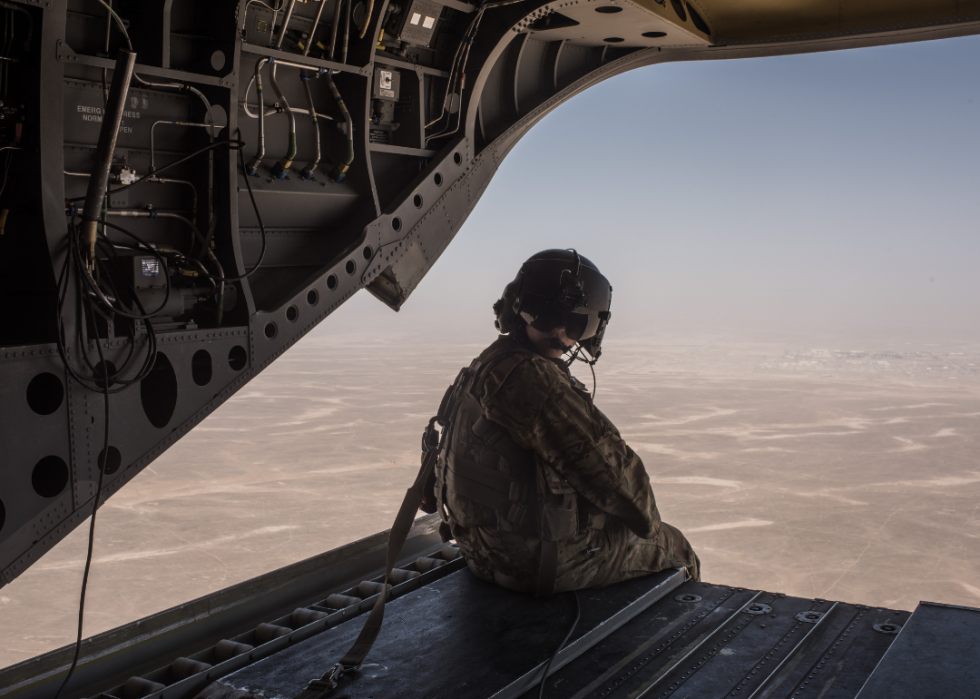
2017: United states of america in Transitional islamic state of afghanistan
A U.S. Ground forces helicopter flies outside of Camp Shorab on a flight to Campsite Mail on Sept. xi, 2017, in Helmand Province, Afghanistan. Near 300 marines were deployed in Helmand Province in a train, advise, and assist role supporting local Afghan security forces. At this betoken, the U.s. had about 11,000 troops deployed in Transitional islamic state of afghanistan, with a reported 4,000 more than expected to arrive in the coming weeks.
You may also like: 10 well-nigh mutual items polluting the ocean
Trending Now
© Stacker 2022. All rights reserved.
hendrickacurt1981.blogspot.com
Source: https://stacker.com/stories/5357/50-historic-photos-american-military-history
0 Response to "Photos of People Coming Back Home Again From War"
Publicar un comentario