What Is an Art Exhibition Vel Garricks Be a Part of It
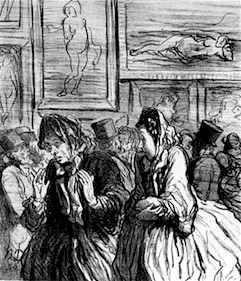
An art exhibition is traditionally the infinite in which art objects (in the most general sense) encounter an audience. The exhibit is universally understood to be for some temporary catamenia unless, as is rarely truthful, information technology is stated to be a "permanent exhibition". In American English, they may be called "showroom", "exposition" (the French word) or "show". In Uk English language, they are always called "exhibitions" or "shows", and an private item in the show is an "exhibit".
Such expositions may present pictures, drawings, video, audio, installation, functioning, interactive art, new media fine art or sculptures by private artists, groups of artists or collections of a specific form of art.
The fine art works may exist presented in museums, art halls, art clubs or private art galleries, or at some place the main business of which is not the display or sale of art, such as a coffeehouse. An important distinction is noted between those exhibits where some or all of the works are for auction, unremarkably in private art galleries, and those where they are not. Sometimes the event is organized on a specific occasion, like a altogether, anniversary or commemoration.
Types of exhibitions [edit]

There are different kinds of art exhibitions,[1] in detail in that location is a distinction betwixt commercial and non-commercial exhibitions. A commercial exhibition or trade off-white is oft referred to as an art off-white that shows the work of artists or fine art dealers where participants generally have to pay a fee. A vanity gallery is an exhibition space of works in a gallery that charges the artist for apply of the infinite. Temporary museum exhibitions typically brandish items from the museum's own collection on a item period, theme or topic, supplemented by loans from other collections, more often than not those of other museums. They normally include no items for sale; they are distinguished from the museum's permanent displays, and nigh large museums ready aside a space for temporary exhibitions.
Exhibitions in commercial galleries are often entirely fabricated upwards of items that are for sale, only may be supplemented past other items that are not. Typically, the company has to pay (extra on summit of the basic museum entrance cost) to enter a museum exhibition, but not a commercial one in a gallery. Retrospectives look back over the work of a single artist; other common types are individual exhibitions or "solo shows", and group exhibitions or "group shows"). The Biennale is a large exhibition held every ii years, often intending to gather together the best of international art; at that place are now many of these. A travelling exhibition is an exhibition seen at several venues, sometimes across the world.
Exhibitions of new or contempo fine art tin be juried, invitational, or open.
- A juried exhibition, such as the Royal Academy Summertime Exhibition in London, or the Iowa Biennial, has an individual (or grouping) interim as estimate of the submitted artworks, selecting which are to exist shown. If prizes are to exist awarded, the estimate or panel of judges will normally select the prizewinners every bit well.
- In an invitational exhibition, such as the Whitney Biennial, the organizer of the prove asks certain artists to supply artworks and exhibits them.
- An open or "non-juried" exhibition, such as the Kyoto Triennial,[2] allows everyone to enter artworks and shows them all. A blazon of exhibition that is usually non-juried is a post fine art exhibition.
History [edit]

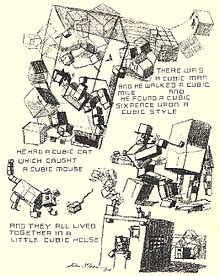
"A Slight Attack of Third Dimentia Brought on by Excessive Study of the Much Talked of Cubist Pictures in the International Exhibition at New York," drawn by John French Sloan in April 1913, satirizing the Armory Show.
The art exhibition has played a crucial part in the market for new art since the 18th and 19th centuries. The Paris Salon, open to the public from 1737, chop-chop became the key factor in determining the reputation, and then the price, of the French artists of the twenty-four hour period. The Purple Academy in London, commencement in 1769, presently established a similar grip on the market, and in both countries artists put great efforts into making pictures that would be a success, often changing the management of their manner to run across popular or critical gustation. The British Institution was added to the London scene in 1805, belongings two annual exhibitions, one of new British art for auction, and one of loans from the collections of its aloof patrons. These exhibitions received lengthy and detailed reviews in the press, which were the principal vehicle for the fine art criticism of the twenty-four hour period. Critics every bit distinguished every bit Denis Diderot and John Ruskin held their readers attention past sharply divergent reviews of unlike works, praising some extravagantly and giving others the most savage put-downs they could think of. Many of the works were already sold, but success at these exhibitions was a crucial mode for an creative person to attract more commissions. Amongst important early i-off loan exhibitions of older paintings were the Art Treasures Exhibition, Manchester 1857, and the Exhibition of National Portraits in London, at what is now the Victoria and Albert Museum, held in three stages in 1866–68.
Every bit the academic fine art promoted by the Paris Salon, always more rigid than London, was felt to be stifling French art, culling exhibitions, now more often than not known as the Salon des Refusés ("Salon of the Refused") were held, near famously in 1863, when the authorities allowed them an annex to the chief exhibition for a prove that included Édouard Manet's Lunch on the Grass (Le déjeuner sur 50'herbe) and James McNeill Whistler'due south Girl in White. This began a period where exhibitions, often ane-off shows, were crucial in exposing the public to new developments in art, and somewhen Modernistic art. Important shows of this type were the Armory Evidence in New York City in 1913 and the London International Surrealist Exhibition in 1936.
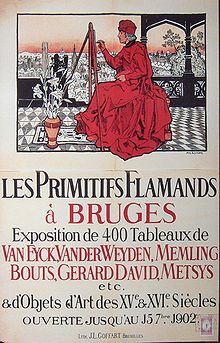
Museums started property big loan exhibitions of historic fine art in the late 19th century, equally also did the Royal Academy, but the modern "blockbuster" museum exhibition, with long queues and a large illustrated catalogue, is generally agreed to take been introduced past the exhibitions of artifacts from the tomb of Tutankhamun held in several cities in the 1970s. Many exhibitions, especially in the days before good photographs were available, are important in stimulating research in art history; the exhibition held in Bruges in 1902 (affiche illustrated below) had a crucial bear on on the study of Early Netherlandish painting.
In 1968, Art fairs in Europe became quite the fashion with the advent of the Cologne Art Fair[iii] which was sponsored by the Cologne Art Dealers Association. Because of the loftier access standards of the Cologne fair a rival fair was organized in Düsseldorf which enabled less regarded galleries opportunity to encounter with an international public. The fairs took place during the fall months. This rivalry continued for a few years which provided the Basel Art Fair the opportunity to interject the Basel fair in early summer. These fairs became extremely important to galleries, dealers and publishers as they provided the possibility of worldwide distribution. Düsseldorf and Cologne merged their efforts. Basel before long became the virtually important fine art fair.
In 1976, the Felluss Gallery nether the direction of Elias Felluss, in Washington DC organized the showtime American dealer art fair. "The Washington International Art Fair" or "Wash Art" for brevity. This American fair met with fierce opposition by those galleries interested in maintaining distribution channels for European artwork already in place. The Washington fair introduced the European idea of dealer fairs to art dealers throughout the United States. Following the advent of Wash Art, many fairs adult throughout the United States.
Preservation bug [edit]
Although preservation issues are oft disregarded in favor of other priorities during the exhibition process, they should certainly exist considered so that possible damage to the drove is minimized or limited. Every bit all objects in the library exhibition are unique and to some extent vulnerable, it is essential that they exist displayed with care. Not all materials are able withstand the hardships of display, and therefore each piece needs to be assessed carefully to determine its power to withstand the rigors of an exhibition. In detail, when exhibited items are archival artifacts or paper-based objects, preservation considerations demand exist emphasized because impairment and change in such materials is cumulative and irreversible.[four] 2 trusted sources – the National Information Standard Organisation'south[5] Ecology Conditions for Exhibiting Library and Archival Materials, and the British Library'south Guidance for Exhibiting Library and Annal Materials – accept established indispensable criteria to assistance curtail the deleterious furnishings of exhibitions on library and archival materials. These criteria may be divided into v main preservation categories: Environmental concerns of the exhibition space; Length of the exhibition; Individual cases; Display methods used on individual objects; and Security.
Environmental concerns of the exhibition space [edit]
- Grooming for Richard Prince, American Prayer exhibition at the Bibliothèque nationale de France, Paris
-
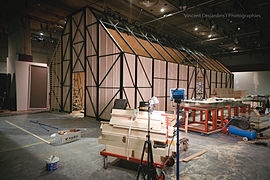
i February 2011
-
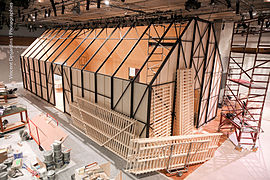
25 February 2011
-

25 February 2011
-

eight March 2011
-

26 June 2011
-

26 June 2011
The main concerns of exhibition environments include low-cal, relative humidity, and temperature.
- Calorie-free
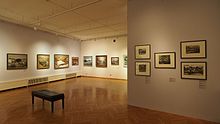
Light is used to draw attending to the exhibits. Interior of Tartu Art Museum with the exhibition "Changing Tartu in Four Views".
Low-cal wavelength, intensity, and elapsing contribute collectively to the rate of material degradation in exhibitions.[6] The intensity of visible light in the display space should be low plenty to avoid object deterioration, but bright enough for viewing. A patron's tolerance of low-level illumination can exist aided by reducing ambient lite levels to a level lower than that falling on the exhibit.[6] Visible light levels should be maintained at between 50 lux and 100 lux depending on the light sensitivity of objects.[seven] An items level of toleration will depend on the inks or pigments being exposed and the duration of the exhibition time. A maximum exhibition length should initially be determined for each exhibited detail based on its calorie-free sensitivity, predictable light level, and its cumulative by and projected exhibition exposure.
Calorie-free levels need to be measured when the exhibition is prepared. UV lite meters will check radiations levels in an exhibit infinite, and information consequence loggers help decide visible light levels over an extended period of fourth dimension. Bluish wool standards cards tin also exist utilized to predict the extent to which materials volition be damaged during exhibits.[8] UV radiations must be eliminated to the extent it is physically possible; it is recommended that light with a wavelength beneath 400 nm (ultraviolet radiation) be limited to no more than 75 microwatts per lumen at x to 100 lux.[ix] Furthermore, exposure to natural light is undesirable because of its intensity and loftier UV content. When such exposure is unavoidable, preventative measures must be taken to command UV radiation, including the use of blinds, shades, curtains, UV filtering films, and UV-filtering panels in windows or cases. Artificial light sources are safer options for exhibition. Amid these sources, incandescent lamps are most suitable considering they emit little or no UV radiation.[10] Fluorescent lamps, common in virtually institutions, may be used only when they produce a low UV output and when covered with plastic sleeves before exhibition.[ten] Though tungsten-halogen lamps are currently a favorite artificial lighting source, they still give off meaning amounts of UV radiations; utilise these only with special UV filters and dimmers.[10] Lights should be lowered or turned off completely when visitors are not in the exhibition space.
- Relative humidity (RH)
The exhibition space'southward relative humidity (RH) should exist set to a value between 35% and l%.[ix] The maximum adequate variation should be 5% on either side of this range. Seasonal changes of v% are also immune. The control of relative humidity is especially critical for vellum and parchment materials, which are extremely sensitive to changes in relative humidity and may contract violently and unevenly if displayed in too dry an environment.
- Temperature
For preservation purposes, cooler temperatures are always recommended. The temperature of the display infinite should not exceed 72 °F.[eleven] A lower temperature of down to l °F tin can exist considered safe for a majority of objects. The maximum acceptable variation in this range is 5 °F, pregnant that the temperature should not go to a higher place 77 °F and below 45 °F. As temperature and relative humidity are interdependent, temperature should be reasonably abiding so that relative humidity can be maintained as well. Controlling the environment with 24-hour air conditioning and dehumidification is the most effective way of protecting an exhibition from serious fluctuations.
Length of the exhibition [edit]
One factor that influences how well materials will fare in an exhibition is the length of the evidence. The longer an item is exposed to harmful ecology atmospheric condition, the more likely that it will experience deterioration. Many museums and libraries have permanent exhibitions, and installed exhibitions take the potential to be on the view without any changes for years.
Damage from a long exhibition is usually acquired past light. The degree of deterioration is different for each respective object. For paper-based items, the suggested maximum length of fourth dimension that they should be on display is three months per yr, or 42 kilolux hours of light per year – whichever comes start.[12]
An exhibition log report, including records of the length of the exhibition time and the light level of the display, may prevent objects from existence exhibited too frequently. Displayed items need to exist inspected regularly for prove of damage or change.[12] Information technology is recommended that high-quality facsimiles of especially frail or frail materials exist displayed in lieu of originals for longer exhibitions.[thirteen]
Private cases [edit]
Library or archival materials are usually displayed in brandish cases or frames. Cases provide a physically and chemically secure environment. Vertical cases are acceptable for small or unmarried-sheet items, and horizontal cases can be used for a variety of objects, including three-dimensional items such equally opened or airtight books, and apartment newspaper items. All these objects tin be bundled simultaneously in 1 horizontal case under a unified theme.
Materials used for instance construction should exist chosen advisedly because component materials can easily become a significant source of pollutants or harmful fumes for displayed objects. Outgassing from materials used in the structure of the exhibition case and/or fabrics used for lining the case can be destructive. Pollutants may cause visible deterioration, including discoloration of surfaces and corrosion. Examples of evaluative criteria to be used in deeming materials suitable for utilize in exhibit display could be the potential of contact-transfer of harmful substances, h2o solubility or dry-transfer of dyes, the dry-texture of paints, pH, and abrasiveness.[14]
New cases may be preferred, constructed of safe materials such as metal, plexiglass, or some sealed forest.[13] Separating sure materials from the display section of an exhibition instance past lining relevant surfaces with an impermeable barrier film will help protect items from damage. Any fabrics that line or decorate the case (for example, polyester blend fabric), and any adhesives used in the process, should also be tested to determine any chance. Using internal buffers and pollutant absorbers, such equally silica gel, activated carbon, or zeolite, is a good way to control relative humidity and pollutants. Buffers and absorbers should be placed out of sight, in the base or backside the backboard of a case. If the instance is to be painted, information technology is recommended oil paints be avoided; acrylic or latex paint is preferable.
Display methods [edit]

A photography exhibition in Moscow, 2010
There are ii kinds of objects displayed at the library and archival exhibition – jump materials and unbound materials. Bound materials include books and pamphlets, and unbound materials include manuscripts, cards, drawings, and other two-dimensional items. The observance of proper brandish conditions will help minimize any potential physical impairment. All items displayed must be adequately supported and secured.
- Unbound materials
Unbound materials, usually single-sheet items, need to exist attached securely to the mounts, unless matted or encapsulated. Metal fasteners, pins, screws, and thumbtacks should not come in direct contact with any exhibit items.[15] Instead, photograph corners, polyethylene, or polyester motion-picture show straps may concord the object to the support. Objects may besides exist encapsulated in polyester film, though old and untreated acidic papers should be professionally deacidified before encapsulation.[xvi] Avoid potential slippage during encapsulation – when possible, use ultrasonic or heat seals. For objects that need to be hung (and that may crave more protection than lightweight polyester flick), matting would exist an effective alternative.
Objects in frames should be separated from harmful materials through matting, glazing, and bankroll layers. Matting, which consists of ii pH-neutral or alkaline boards with a window cut in the elevation board to enable the object to be seen, can be used to support and enhance the display of single sheet or folded items. Backing layers of archival cardboard should be thick plenty to protect objects. Moreover, any protective glazing used should never come in direct contact with objects.[17] Frames should exist well-sealed and hung deeply, assuasive a space for air apportionment between the frame and the wall.
- Leap materials
The most mutual style to display bound materials is closed and lying horizontally. If a book is shown open, the object should exist open merely as much equally its binding allows. Common practice is to open volumes at an angle no greater than 135°.[18] There are some types of equipment that assistance support volumes as they displayed openly: blocks or wedges, which concur a book cover to reduce stain at the book swivel; cradles, which support jump volumes every bit they lay open without stress to the binding construction; and polyester movie strips, which aid to secure open up leaves. Textblock supports are best used in conjunction with book cradles where the textblock is greater than 1/2 inch, or where the textblock noticeably sags.[19] Regardless of its method of back up, all the same, information technology is worth noting that any volume that is kept open up for long periods can cause damage. Ane should plow an exhibited volume'south pages every few days in order to protect pages from overexposure to light and spread whatsoever strain on the binding structure.
Security [edit]
Because exhibited items are often of special interest, they demand a high level of security to reduce the adventure of loss from theft or vandalism. Exhibition cases should be securely locked. In addition, cases may exist glazed with a material that hinders penetration and that when broken does non take chances shards of glass falling on the exhibits.[20] Whenever possible, the exhibition area should exist patrolled; a 24-hr security presence is recommended when precious treasures are exhibited.[21] Finally, the exhibition is all-time protected when equipped with intruder alarms, which can exist fitted at entry points to the edifice and internal areas.
See also [edit]
- Arts festival
- Exhibition history
- Listing of museums
Notes [edit]
- ^ "Definition of EXHIBITION". world wide web.merriam-webster.com . Retrieved 16 April 2021.
- ^ Kyoto Triennial
- ^ "Fair for modern and contemporary fine art | ART COLOGNE".
- ^ Mary Todd Glaser, "Protecting Newspaper and Volume Collections During Exhibition," Northeast Certificate Conservation Eye, NEDCC.org Archived 28 August 2008 at the Wayback Machine. Retrieved 9 August 2009.
- ^ "NISO.org". Archived from the original on 12 May 2015. Retrieved 10 August 2009.
- ^ a b National Preservation Part, Guidance for Exhibiting Library and Archive Materials, Preservation Management Serial (London: British Library, 2000), 2.
- ^ National Information Standards System, Environmental Weather condition for Exhibiting Library and Archival Materials (Bethesda, Physician: NISO Printing, 2001), vi.
- ^ Gary Thompson, The Museum Environment, 2nd edn (London: Butterworths, 1986), 183.
- ^ a b NISO, vi.
- ^ a b c Edward P. Adcock, IFLA Principles for the Care and Handling of Library Material (Paris: IFLA, 1998), 27.
- ^ Adcock, IFLA Principles for the Care and Treatment of Library Material (1998), eight.
- ^ a b Adcock, IFLA Principles for the Care and Handling of Library Material (1998), half dozen.
- ^ a b Nelly Balloffet and Jenny Hille, Preservation and Conservation for Libraries and Archives (Chicago: ALA, 2005), 37.
- ^ NISO, 10.
- ^ Balloffet and Hille, Preservation and Conservation for Libraries and Archives (2005), 11.
- ^ Glaser, NEDCC.org Archived August 28, 2008, at the Wayback Machine. Retrieved 9 Baronial 2009.
- ^ Gail E. Farr, Archives and Manuscripts: Exhibits (Chicago: Society of American Archivists, 1980), 42.
- ^ NISO, 12.
- ^ NPO, six.
- ^ Balloffet and Hille, Preservation and Conservation for Libraries and Archives (2005), 154.
- ^ Gail E. Farr, Athenaeum and Manuscripts: Exhibits (Chicago: Gild of American Archivists, 1980), 22.
References [edit]
- O'Doherty, Brian and McEvilley, Thomas (1999). Within the White Cube: The Credo of the Gallery Space. University of California Press, Expanded edition. ISBN 0-520-22040-4.
- New York School Abstract Expressionists Artists Pick by Artists, New York School Press, 2000. ISBN 0-9677994-0-6.
- National Data Standards Organization. Environmental Conditions for Exhibiting Library and Archival Materials. Bethesda, Md: NISO Press, 2001.
- National Preservation Role. Guidance for Exhibiting Library and Annal Materials. Preservation Management Series. London: British Library, 2000.
- Francis Haskell, The Imperceptible Museum: Old Principal Paintings in the Rising of Art Exhibition, Yale University, 2000.
- Bruce Altshuler, Salon to Biennial: Exhibitions That Made Art History. Volume I: 1863–1959, Phaidon Editors, 2008.
- Bruce Altshuler, Biennials and Beyond: Exhibitions That Made Art History. Volume II: 1962–2002, Phaidon Editors, 2013.
- Where Art Worlds Encounter: Multiple Modernities and the Global Salon, ed. Robert Storr, Marsilio, 2005.
- What Makes a Great Exhibition, ed. Paula Marincola, Philadelphia Exhibitions Initiative, 2006.
- Hans Ulrich Obrist, A Brief History of Curating, Zurich-Dijon, 2008.
External links [edit]
- Art Calendar week, 40 years for Art Exhibition
- nine tips to help you prepare your offset art exhibition
- OpenArt - Mag about Art Exhibitions in Republic of india and worldwide
hendrickacurt1981.blogspot.com
Source: https://en.wikipedia.org/wiki/Art_exhibition
0 Response to "What Is an Art Exhibition Vel Garricks Be a Part of It"
Publicar un comentario